Raw fish is one of the most technically demanding requests in private aviation catering. Passengers expect sushi as fresh as a top Tokyo counter, plated cleanly, at the right temperature, and safe to eat after hours in the cabin. Meeting that expectation calls for tight sourcing, disciplined cold-chain handling, and cabin crew who understand how to present each piece. Small execution errors become obvious the moment the box is opened.
Global private aviation activity has continued to grow through 2025 and into 2026, and with it, guest expectations for restaurant-grade cuisine on board. Sushi and sashimi sit near the top of the request list on long-haul flights and business trips through Asia, and increasingly on transatlantic routes where passengers want lighter, protein-forward meals. Understanding how this category is delivered helps flight departments brief their catering partners with confidence.
Why Sushi and Sashimi Demand a Different Standard at 40,000 Feet
Raw fish has almost no margin for error. Temperature abuse, rough handling, or a break in packaging can compromise both safety and quality within minutes. On the ground, a sushi chef controls every variable from the fish counter to the plate. In the air, that same plate has to travel through a caterer’s kitchen, a ramp handler, a security check, and a galley before it reaches the guest. Each step introduces risk.
Cabin conditions add another layer. Low humidity dries out rice quickly, dulls the aroma of the fish, and stiffens seaweed. Reduced air pressure affects how the palate reads salt, umami, and fat. Nigiri that tasted balanced in the kitchen can read flat at cruise. The best providers season slightly more assertively for altitude and choose fish with higher natural fat content, such as chutoro or wild-caught salmon, because they hold their character better in dry cabin air.
The Cold Chain Behind Safe Raw-Fish Service
Safe raw-fish service depends on an unbroken cold chain from harvest to handover. Fish intended for raw consumption must be frozen to specific parameters to inactivate parasites before service, a standard published by the U.S. Food and Drug Administration and mirrored by most national food safety authorities. Reputable caterers document these controls under a HACCP framework, with time and temperature logs available on request.
For inflight service, the working temperature range is tighter than in a restaurant. Sushi should be held at or below 4°C from preparation through delivery, then presented within a defined window once opened onboard. Cabin crew are typically briefed on the exact hold time so nothing sits in the galley beyond its safe window. Dry ice, gel packs, and vacuum-insulated transport boxes are standard for longer ramp times, particularly at hot-climate airports where ambient temperatures can spike quickly.
Clear guidance on catering timelines, packaging, and delivery protocols is one reason flight departments work with established partners. Our overview of the rules of catering on private jets covers the compliance points most crews ask about before uplift.
Sourcing: Where the Fish Actually Comes From
Quality starts with the fish, and sourcing separates serious providers from the rest. Premium inflight sushi is typically built around fish auctioned at Toyosu in Tokyo, Norwegian salmon farms with traceable origin certificates, or Mediterranean bluefin operations working within international quota rules.
For a private jet order, the practical questions are simple. Was the fish handled by a supplier with sushi-grade credentials? How many hours from harvest to plate? Is the cut appropriate for the passenger’s preference, say akami for a cleaner bite or otoro for richness? Providers who cannot answer these questions quickly are usually not the right fit for VIP raw-fish service.
Rice matters almost as much. Short-grain Japanese rice, seasoned with a precise vinegar, sugar, and salt ratio, is what holds nigiri together and carries the fish’s flavour. Skilled kitchens prepare the rice within a narrow window before departure so it reaches the guest at the correct texture, neither dry nor gluey.
Onboard Presentation and Timing
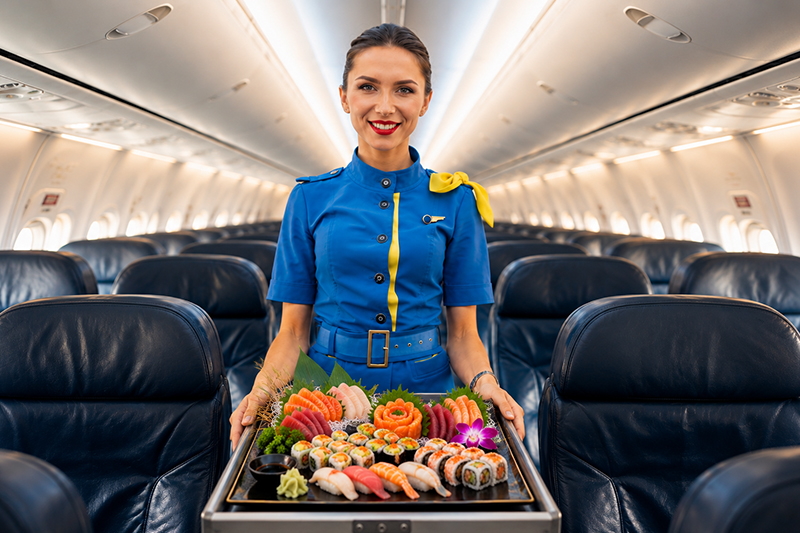
Presentation is part of the product. Wooden geta boards, cedar boxes, or slate platters signal quality the moment the meal is served. Garnishes travel separately, with wasabi, pickled ginger, and soy portioned into sealed containers so flavours do not migrate during flight.
Timing is coordinated with the cabin crew. On short sectors, sushi is served shortly after level-off. On longer routes, orders are often split into two services, with sashimi first and hand-rolled temaki assembled onboard from prepped components so the nori stays crisp. This kind of sequencing needs to be planned before departure, not improvised in the galley.
For principals who want a fully bespoke sushi service, working with a provider that curates menus around the passenger’s preferences pays off. Our approach to premium private jet catering and bespoke meal options explains how these menus are built and adjusted for each flight.
Cultural Sensitivity and Passenger Preferences
Raw-fish preferences vary widely across regions and cultures. Japanese principals often expect a traditional edomae style with restrained garnishing and a specific order of service. Guests from the Gulf may prefer halal-certified sourcing, alcohol-free accompaniments, and salmon or yellowtail over shellfish. North American travellers frequently request creative rolls alongside classic nigiri, while European passengers tend toward sashimi with a lighter carbohydrate load.
A good caterer asks these questions before quoting the menu, not after. Dietary restrictions, religious requirements, and allergy protocols must be captured in writing and communicated to every kitchen involved in the order.
What Sets the Best Providers Apart
Not all flight catering companies handle raw fish at the same level. The providers worth shortlisting share a few characteristics:
- Documented HACCP procedures specific to raw-fish handling, with recent audit records available
- Direct supplier relationships with sushi-grade fish importers, not general seafood wholesalers
- Trained sushi chefs on the roster rather than generalist cooks assembling pre-cut fish
- Purpose-built cold packaging validated for the airport’s ramp conditions and expected uplift time
- Clear service windows communicated to the crew, with written guidance on onboard hold and presentation
A useful shortcut when evaluating a new partner is to ask how they would handle a last-minute sushi order at a difficult airport with a short ramp window. The answer reveals whether the operation actually runs on process or on improvisation.
Bespoke Service for Repeat VIP Clients
For principals who fly regularly and expect a very specific standard, engaging an inflight chef through the caterer brings the kitchen closer to the guest. This works well for repeat routes, family offices with defined preferences, and multi-leg trips where menus must evolve without repetition. The chef briefs the caterer at each stop, confirms sourcing, and adjusts seasoning for the cabin.
Managing sourcing, timing, cultural preferences, and crew briefings across multiple stops is where the operational side becomes complex. Our guide on the smartest way to manage inflight catering is a practical reference for flight departments coordinating repeat sushi orders across different regions.
Bringing It All Together
Serving sushi and sashimi in the air is a serious operational commitment, not a menu tick-box. It requires disciplined sourcing, tight cold-chain control, cabin-aware seasoning, culturally informed menu design, and crew coordination that leaves nothing to chance. When those pieces are in place, the result is a raw-fish service that stands up to the passenger’s memory of the best sushi counters they have visited, delivered thousands of feet above them. Dark Wing Inflight coordinates this level of sushi service across 2,000+ airports through a network of 2,800+ partners, including Michelin-star chefs and specialist Japanese kitchens, with 24/7/365 multilingual support for flight departments and principals. Getting the brief right at the quote stage is what makes the difference between a good sushi tray and one that genuinely impresses at altitude.
Frequently Asked Questions
How safe is sushi served on a private jet?
Sushi served through a reputable inflight caterer is prepared under HACCP-controlled conditions, using fish that meets sushi-grade freezing standards to inactivate parasites. Temperature is monitored from kitchen to galley, and cabin crew are briefed on safe hold windows. On a well-run flight, the safety profile is comparable to a high-end restaurant.
How far in advance should sushi be ordered for a private flight?
For most airports, a 12 to 24 hour lead time is preferred so the kitchen can source the correct fish and prepare it fresh. Last-minute requests are possible at major hubs with established Japanese supply chains, but menu flexibility narrows as lead time shrinks.
Can sushi be served on long-haul flights?
Yes, with the right packaging and service planning. On long sectors, the order is often split into two services, with sashimi and nigiri first, and hand-rolled items assembled onboard from prepared components. This keeps textures right throughout the flight.
What is the difference between sushi and sashimi for inflight service?
Sashimi is sliced raw fish served without rice, while sushi includes seasoned rice as a base. Sashimi travels slightly better because there is no rice to dry out, but both can be delivered at a high standard with proper cold-chain handling and timing.
Which airports are best suited to premium sushi catering?
Airports with strong Japanese culinary supply chains, including Tokyo, Hong Kong, Singapore, London, New York, Los Angeles, Dubai, and Paris, offer the widest sushi options. Coverage extends well beyond these hubs through specialist partner networks in secondary cities.