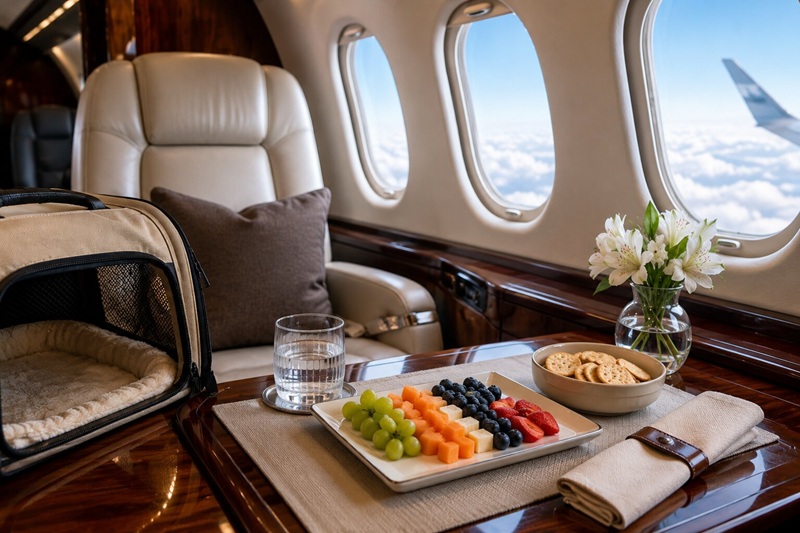
Pets have quietly become full passengers on private aviation flights. Owners now expect the same care for a Cavalier King Charles Spaniel or a Bengal cat that they receive themselves, from the seat setup to what appears in the bowl at cruise altitude. Feeding animals well on a jet is more technical than most flight departments assume. Food safety, motion sensitivity, sourcing across international borders, and species-specific nutrition all shape what should and should not go onboard. This guide explains how in-flight pet catering is planned, prepared, and delivered on private aircraft, and what principals, flight departments, and charter operators should ask for when a four-legged passenger is on the manifest.
Why Pet Catering Deserves Its Own Playbook
The private aviation market has shifted meaningfully around pet travel. According to industry reporting on WingX private aviation traffic tracking in 2025, business jet activity remained strong through the year, with a growing share of flights carrying at least one animal onboard. Owners flying long international sectors want a meal plan for their pet that mirrors home routine, not a bag of dry kibble tossed into a galley drawer.
There are three practical reasons pet catering has become a specialist workstream:
- Cabin comfort. A pet that eats unfamiliar food at altitude often experiences digestive distress, which becomes a shared cabin problem within minutes.
- Health continuity. Working dogs, senior pets, and animals on prescription diets cannot break routine without measurable welfare risk.
- Reputation. Charter guests notice small details. A named bowl, a species-correct treat, and a hydration plan tell them the operator understands luxury service at every level.
Understanding the Dietary Profile of a Traveling Pet
Good pet catering begins with a short intake conversation with the owner or the traveling handler. The information gathered before departure shapes every downstream decision.
Key intake points to confirm:
- Species, breed, age, and approximate weight.
- Current daily diet, including brand, protein source, and portion size.
- Known allergies or intolerances, such as chicken, grain, or dairy.
- Prescription or therapeutic diets ordered by a veterinarian.
- Feeding schedule against the flight timeline, adjusted for time zones.
- Treat preferences, chew toys, and any calming aids used during travel.
For principals who fly with pets regularly, this intake becomes a standing profile stored against the tail number, so repeat requests do not restart the conversation from scratch. Our guide on the smartest way to manage inflight catering shows how these profiles reduce coordination time before short-notice departures.
Building a Safe In-Flight Menu for Pets
Menu design for animals follows a different logic than human catering. The goal is nutritional continuity, not novelty. A jet is not the place to introduce a new protein or a rich human-food indulgence, both of which commonly trigger vomiting or loose stool in the cabin.
For dogs
- Plain cooked chicken, turkey, or white fish with rice.
- Steamed carrots, green beans, or plain pumpkin puree for fiber.
- The owner's regular kibble, portioned and sealed in labeled containers.
- Low-sodium bone broth for hydration and appetite support on long sectors.
For cats
- Cooked chicken breast or salmon, boneless and unseasoned.
- The owner's regular wet or dry food, kept refrigerated where possible.
- Small freeze-dried treats that travel well without refrigeration.
Foods to keep off the aircraft
Several common ingredients are unsafe for pets and should never appear in a jet galley intended for animal feeding. The ASPCA list of foods toxic to pets, updated in 2025, identifies chocolate, grapes and raisins, onions and garlic, xylitol, macadamia nuts, and alcohol as the highest-risk items. Crews should also avoid heavily seasoned leftovers from the principal's tray, which are the most common source of accidental exposure.
Handling Special Diets and Medical Requirements
A meaningful share of pets flying privately are on some form of managed diet. Senior dogs on renal formulas, cats with pancreatitis histories, and working dogs with high-protein needs all require food prepared to specification, not substituted at the airport. When we plan private jet food catering for a client traveling with a prescription-fed pet, we source the exact SKU in the departure city and, where import rules allow, arrange the same product at the destination for the return leg. Medication timing is coordinated with feeding, because many veterinary drugs are dosed with food. A short written brief for the cabin crew, listing meal times, portion sizes, and any pill schedule, prevents confusion when a flight attendant is also managing multiple human passengers.
Hydration, Portioning, and Cabin Presentation
Dehydration is the single most underestimated risk on long flights with pets. Cabin humidity typically sits well below what an animal experiences at home, and many pets refuse to drink from unfamiliar bowls. A few practical steps make a large difference:
- Bring the owner's bowl from home, or supply a non-slip weighted bowl that will not skid during light turbulence.
- Offer water in small, frequent servings rather than one large bowl left out.
- For reluctant drinkers, add a spoon of low-sodium broth or a lick mat with wet food.
- Portion meals into single-serve sealed containers, labeled with the pet's name and the intended service time.
Presentation matters even for animals. A ceramic bowl on a small silicone mat reads very differently from a foil tray on the carpet, and principals notice.
Temperature Control and Onboard Storage
Food safety rules for animal meals are the same as those for human passengers, and the small size of a private jet galley makes discipline more, not less, important. Raw or lightly cooked proteins prepared for a pet must move from the ground kitchen into a temperature-controlled transport, then into the aircraft chiller within a defined window. Any meal held above four degrees Celsius for longer than two hours should be discarded, regardless of whether the animal has touched it. On flights longer than six hours, we split the plan into two or three service windows, each with its own sealed container, so nothing sits out at cabin temperature waiting for the pet to feel hungry.
Storage labeling helps the crew move quickly. A simple color code on containers, one shade for the principal, another for the pet, prevents mix-ups when service picks up around mealtime. For flights carrying more than one animal, each container should also carry the pet's name and the intended service time in clear print. These are small operational details, but they are the details that separate a professional catering operation from an improvised one.
Coordinating With the Flight Crew and the Owner
The best pet catering fails if the cabin crew is not briefed. Before departure, the caterer should provide a one-page service plan covering feeding windows, portion sizes, storage locations onboard, allergy notes, and emergency contact for the owner's veterinarian. On repositioning legs, when the pet may be traveling with a handler rather than the principal, the plan matters even more. For operators building this coordination into standard procedure, our overview of the rules of catering on private jets offers a useful framework that adapts cleanly to animal service.
Owner communication runs alongside crew coordination. A short pre-flight message confirming the menu, the feeding schedule in destination time, and any changes to the pet's routine gives the principal confidence that nothing has been left to chance. If the pet is nervous around food during travel, we recommend a small familiar snack in the first thirty minutes of the flight, followed by the main meal once cruise altitude is stable. Handlers appreciate being told, in advance, exactly where the pet's food and water are stowed, so they can serve without asking the crew mid-flight.
Global Sourcing, Customs, and Multi-Leg Trips
International pet travel adds a layer of complexity that generic caterers rarely handle well. Some countries restrict the import of raw meat, fresh produce, or specific prescription pet foods. On multi-leg itineraries, food prepared at the origin cannot always cross a border on the aircraft, which means the same menu must be sourced fresh at each stop. This is where a global partner network changes what is possible. With relationships across more than 2,000 airports, our team can pre-position a matching menu in Nice, Dubai, Teterboro, or Singapore, so a Bernese Mountain Dog eats the same meal in the same bowl from London to Los Angeles. For business jet catering that includes animal passengers, this continuity is often the difference between a smooth trip and a stressed pet arriving at the destination off food for a day.
Bringing It All Together
Pet catering onboard a private jet is a small brief with a large impact on the trip. The families and principals who fly with animals are usually the most detail-oriented clients an operator serves, and the bowl at 41,000 feet becomes a proxy for how the whole flight is being run. Getting it right takes three things: an honest intake conversation with the owner, a menu built around continuity rather than novelty, and a supply chain that can repeat the same standard in every city on the itinerary. Dark Wing Inflight builds each of these into the catering plan from the first request, working across time zones with a 24/7/365 multilingual team so a last-minute reroute never means a compromise on the pet's meal. Handled well, in-flight pet catering is quiet, invisible, and remembered warmly long after landing.
Frequently Asked Questions
Q1. Can pets eat regular in-flight catering meals?
They should not. Human in-flight meals are seasoned, salted, and often contain onion, garlic, or fats that are unsafe for dogs and cats. Pet meals should be prepared separately, plain, and portioned to the animal's normal diet.
Q2. How far in advance should pet catering be arranged?
For prescription diets or exotic species, 48 to 72 hours is ideal so we can source the correct product locally. For standard dog and cat menus, 12 to 24 hours is usually enough at major airports, and our 24/7 team can handle shorter windows on request.
Q3. Is pet food subject to the same HACCP standards as human catering?
Yes, when prepared by a professional inflight caterer. All food handled in our kitchens follows HACCP protocols for temperature, storage, and cross contamination, whether it is intended for the principal or the pet.
Q4. Can the same menu be provided at every stop on a multi-leg trip?
In most cases, yes. With a global partner network across 2,000 plus airports, we can arrange matching menus at each destination, subject to local import rules on meat, dairy, and specific pet food brands.
Q5. What information do you need to plan pet catering?
Species, breed, weight, current diet including brand and protein source, any allergies or prescription requirements, feeding schedule, and treat preferences. A short intake at the first booking creates a reusable profile for future flights.