Most corporate flight attendants will tell you the same thing. The hardest part of the job is not the long duty days or the demanding principals. It is the pressure of running a full restaurant experience alone, in a 40-square-foot galley, at 45,000 feet, with no chance to run to the back for a forgotten spoon. Global business jet activity remained near record highs into 2025, with WingX recording 3.9 million departures for the year, the highest annual total on record and 5 percent above 2024. More flights mean more service turns, tighter cabin schedules, and less margin for a scramble at boarding.
Efficient service is not about working faster. It is about removing friction before the flight even starts. What follows is a working framework used by senior corporate flight attendants to keep the cabin calm, the principal well fed, and their own stress level manageable.
The context has shifted as well. Duty periods are longer, mission profiles are less predictable, and principals expect a hotel-grade cabin experience on legs where the catering window is under three hours. Add the growing mix of dietary preferences, faith-based requirements, and clinical restrictions the modern cabin sees on a single manifest, and the margin for improvisation shrinks further. The playbook below is written for that reality.
Start with the flight, not the menu
Before a single canape is ordered, understand the shape of the trip. Efficiency comes from matching the service to the mission, not from stocking an ambitious menu you cannot execute in the cabin you have.
Three inputs decide everything else:
- Who is on board and what they actually eat, drink, and avoid
- How long the leg is, and what time it lands in local time
- What galley you are working with, including oven type, refrigeration volume, and water supply
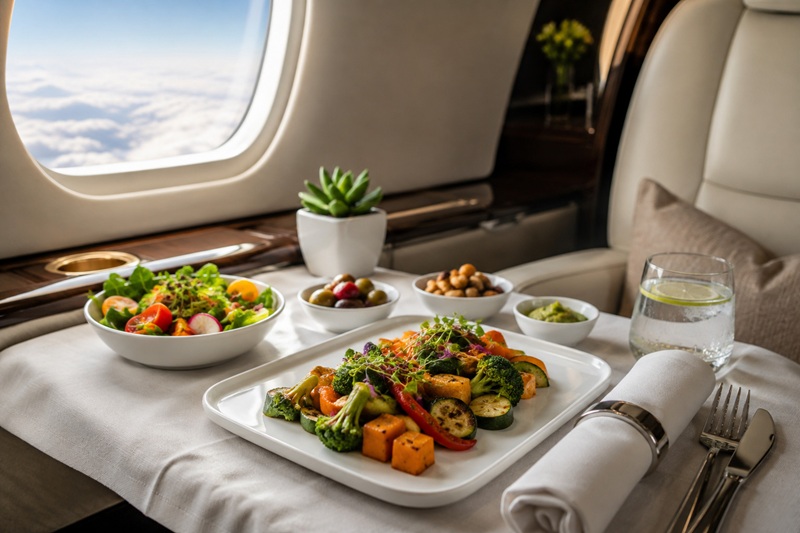
A four hour night flight to Geneva with a principal who lands and goes straight to bed is a very different assignment from a two hour day flight with three executives running a working session. One needs a light supper and a quiet turndown. The other needs coffee that keeps coming and a fast, hot main course. Design the service around the mission first, then choose the food.
A quick working test before ordering: can you plate, serve, clear, and reset for the next course inside the actual quiet window on this leg? If the answer is no, cut a course. A well executed three-course dinner beats an ambitious five-course menu that arrives cold because the seatbelt sign came back on during salmon.
Pre-flight prep is where you win the trip
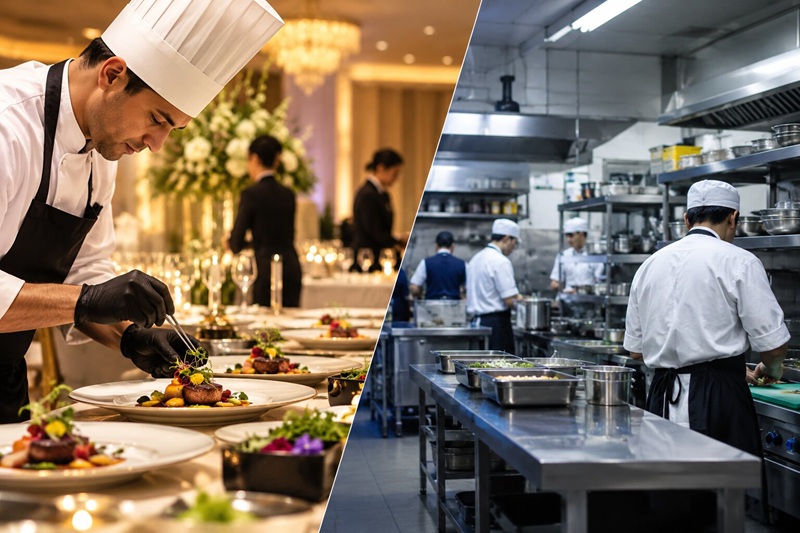
Senior corporate flight attendants say the same thing again and again. The trip is won or lost the night before, not on the ramp. This is where a professional inflight catering service partner becomes the single biggest lever you have. The right partner delivers labeled, temperature-controlled, aviation-ready packaging so you are not repacking on the ramp in the rain.
A tight pre-flight checklist keeps prep predictable:
- Confirm passenger count, dietary restrictions, and allergies in writing, twice
- Place the catering order with a clear delivery window and a galley-friendly packaging spec
- Load the galley by service sequence, not by item type, so the first thing you serve is at the front
- Chill drinks, ice, and glassware before boarding, never after
- Stage a small backup kit with shelf-stable options for delays or diverts
The National Business Aviation Association highlights unscheduled schedule changes as one of the top operational stressors reported by cabin crew across US business aviation flight departments. Building a delay-ready pantry is not a luxury. It is baseline planning.
Service choreography beats service speed
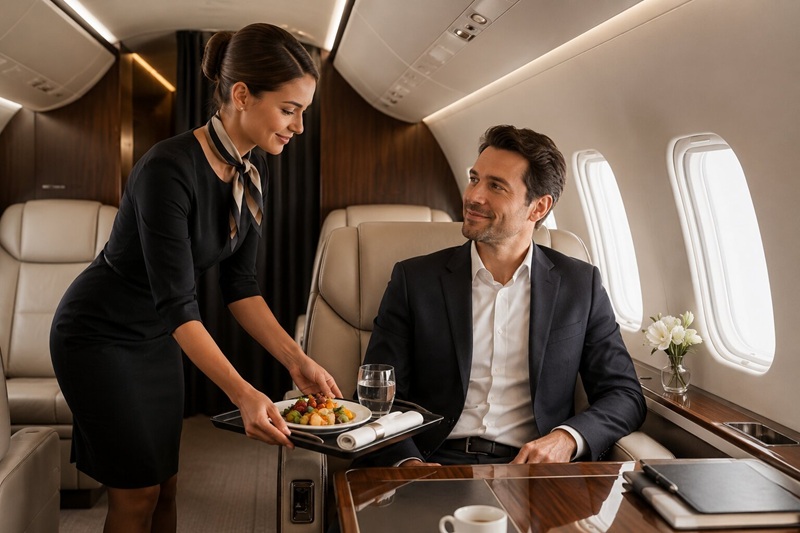
Rushed service reads as anxious service. The real trick in a small cabin is choreography, moving in a fixed order so passengers stop tracking you and start relaxing. A useful pattern:
- Welcome drink and hot towel within four minutes of the seatbelt sign going off
- A short check-in to confirm meal timing, not to hover
- First course plated in the galley, walked out together on one tray where possible
- Clear plates in one pass, not two, using a folded linen as a bus tray
- Coffee and digestifs offered once, then left visible on the credenza for self service
Reading the cabin matters more than sticking to the plan. If the principal opens a laptop and starts a call, hold the entree, refresh the water, and disappear. Anticipation without hovering is what separates a senior corporate flight attendant from a new one. The passenger should not feel served. They should feel looked after.
Two habits sharpen this instinct fast. First, note the small tells at boarding: what they order in the lounge, how they hold their coffee, whether they take their jacket off before takeoff. Those cues predict service preferences more reliably than any preference sheet. Second, keep one silent visual sweep every 15 minutes on cruise. A quiet cabin is not the same as a settled cabin, and the difference is usually visible before it is asked for.
Galley discipline: quiet, clean, cold, hot
The galley is the engine room. If it is chaotic, the cabin will feel chaotic. Three habits keep it under control.
- Clean as you go. Never let two tasks stack up. A clear counter is a clear head.
- Log temperatures. HACCP-aligned catering partners deliver with time and temperature tags. Keep cold items below 5 degrees Celsius and hot items above 63 degrees Celsius through service. A short handover log at boarding pays back on any post-flight query.
- Rehearse the turbulence protocol. Know which drawer holds the hot items, which latch is loose, and what gets stowed first. Light turbulence encounters have trended upward across busy corridors in recent EASA safety reporting, which makes a rehearsed stow-and-secure routine more important than most crews realise.
Work your catering partner like a teammate
The best crews treat their corporate aircraft catering provider as an extension of the cabin, not a vendor. That means sharing more, not less. Send the exact tail number, galley type, oven wattage, principal preferences, allergen history, and any recent menu fatigue. Ask the caterer to sign off on packaging that fits your specific drawers.
A strong partner will:
- Confirm orders in writing with clear cutoff times
- Package for the specific galley, not a generic jet
- Flag allergens and cross-contamination risk on every label
- Offer a genuine 24/7 line for last minute changes and diverts
Dark Wing Inflight, for example, coordinates across a network of more than 2,800 restaurants, VIP caterers, luxury hotels, and Michelin-star chefs in over 2,000 airports across 135 countries, with 24/7/365 multilingual dispatch. That reach matters most when the trip changes at 2 a.m. and you need a hot breakfast in Reykjavik that was supposed to be a cold lunch in Nice.
For crews who fly repeatedly into the same hubs, building a shortlist of trusted providers per station saves hours over a year. Our guide on the smartest way to manage inflight catering covers how senior flight departments standardise this across a route network.
Recover well when the plan breaks
Every experienced corporate flight attendant has a story. Catering arrived cold. An allergy was announced at boarding. The leg extended by ninety minutes. Zero-stress service does not mean nothing goes wrong. It means you have already decided what to do when it does.
Three recoveries worth pre-planning:
- Missing item: know your substitution tree by category, not by dish, so any protein can slot into any course
- Allergy surprise: keep a sealed, labeled allergen-safe kit with a documented supply chain
- Extended leg: carry a delay pantry sized for one extra service round per passenger
Documenting these recoveries after each trip is what turns a good crew member into an operator. Small notes compound into a personal operations manual within a year.
A five minute post-flight debrief with yourself is enough. What worked, what nearly did not, and what the caterer needs to hear before the next order. Share the last part with your provider in writing. A caterer who never gets feedback cannot improve for you, and the trips where nothing gets said tend to repeat the same small friction points on the next rotation.
Cultural fluency saves service time
Global rosters mean global menus. A crew flying between the Middle East, Europe, and Asia in the same week is dealing with halal certification on one leg, kosher packaging on the next, and Jain preparation restrictions on the one after. Efficient service treats these as planning inputs, not exceptions. Ask the caterer for certification documentation up front, keep sealed originals in the galley, and confirm the chain of custody on delivery. The five minutes spent verifying at boarding removes the twenty minute conversation nobody wants at 38,000 feet.
The quiet standard
Efficient inflight service is not about doing more. It is about doing the right things in the right order, with a catering partner who has already thought through the awkward parts. Senior corporate flight attendants build systems, not heroics. The principal notices calm, not effort, and the quiet cabin is the standard the industry has been moving toward all year.
Fly a calmer cabin with a partner who plans ahead
If you are building or reviewing a catering playbook for your flight department, our team can help stress test it against real operating conditions across your route network. Explore how our global partner network handles complex catering rules on private jets, request a tailored menu for an upcoming trip, or speak with a coordinator directly. We are reachable at info@darkwinginflight.catering, on +44 204 577 0985, or WhatsApp +33 787 346 458. Our dispatch runs 24 hours a day, 365 days a year, across more than 2,000 airports globally. One order, one point of contact, one accountable team behind every cabin service, no matter how late the schedule changes or how remote the field.
FAQs
1. What does a corporate flight attendant do that a commercial cabin crew member does not?
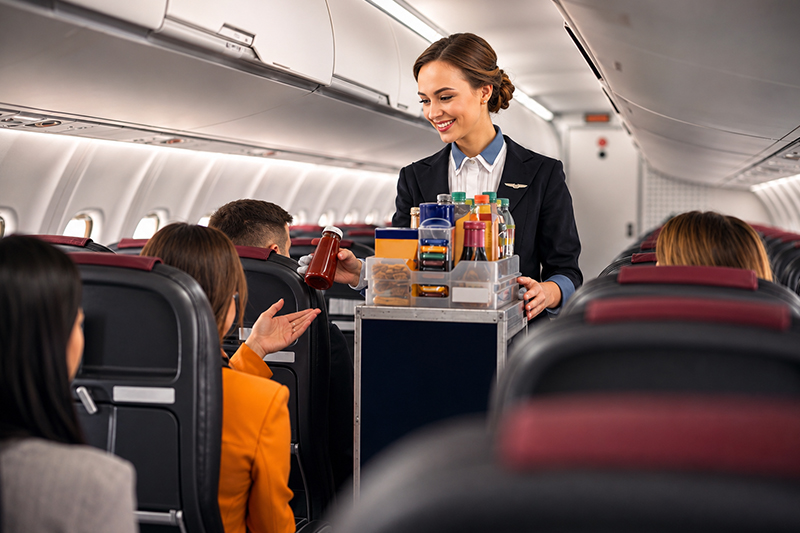
A corporate flight attendant runs the entire cabin experience alone for a small group of principals, usually two to twelve passengers. That covers catering coordination, service, safety, cabin conditioning, laundry, and often trip planning support. Unlike commercial crew, there is no galley team and no service cart. Every decision from menu design to plating sequence is made in advance and executed solo, often at short notice and across multiple time zones in a single duty period.
2. How far in advance should catering be ordered for a private jet flight?
For domestic legs, 12 to 24 hours is the working standard. For international trips, allergy-heavy manifests, or specialty menus, 48 to 72 hours gives the kitchen time to source ingredients and coordinate with airport handlers. Same day and short notice orders are possible with the right partner, especially those operating true 24/7 dispatch across major business aviation hubs, which is where a global network with local kitchens genuinely earns its keep on tight turnarounds.
3. How do senior flight attendants keep food safe in flight?
By following the cold chain from delivery to service. That means logging temperatures at handover, storing cold items below 5 degrees Celsius, holding hot items above 63 degrees Celsius, and separating allergens with sealed, labeled packaging. Working with HACCP-aligned caterers who deliver in aviation-grade, temperature-tracked packaging removes most of the risk before it reaches the galley, and a simple handover log at boarding closes the paper trail.
4. What is the biggest cause of inflight service stress and how do you prevent it?
Last minute changes. Passenger additions, delayed catering, unexpected diverts, and undisclosed allergies cause more cabin stress than any other single factor. Prevention comes down to a written pre-flight checklist, a delay-ready pantry, a documented substitution tree, and a catering partner with a real 24/7 dispatch and multi-station coverage. Systems absorb the shock so the crew does not have to.
5. Which airports are hardest for private jet catering and how do crews manage them?
Remote leisure destinations, secondary hubs across parts of Africa and Central Asia, and airports with tight slot windows are historically the trickiest. Crews manage them by ordering earlier, choosing partners with a genuine global network rather than a single-city vendor, and confirming packaging, allergen handling, and handover logistics with the FBO in writing before departure. A single accountable point of contact matters more than a long vendor list.