Plant-based passengers are no longer a niche request on a charter manifest. Flight departments routinely receive briefs specifying strict vegan requirements, ayurvedic preferences, or mixed cabins where meat eaters and plant-focused guests share the same table at 41,000 feet. Getting these menus right is a matter of sourcing precision, cultural fluency, and food safety discipline, not a scaled-down version of the standard tray. This guide walks flight departments and cabin crew through the practical decisions behind vegetarian and vegan inflight menus: what to source, how to plate for altitude, and how to protect guests from cross-contact risk.
Why Plant-Based Demand Is Reshaping Private Aviation Menus
The global plant-based food market was valued at USD 14.2 billion in 2025 and is forecast to reach USD 49.5 billion by 2036 at a 12 percent CAGR, according to Future Market Insights research on plant-based food demand. Flexitarian buyers now account for over 60 percent of category volume, meaning the guest asking for a vegan dinner tomorrow is often the same guest who ordered wagyu last week.
For private aviation, this shift shows up as:
- More mixed-diet cabins, with two or three dietary profiles on a single leg
- Higher expectations of quality parity between meat and plant-based courses
- Growing pressure to disclose ingredient origin, allergens, and processing methods
Principals with health, ethical, or religious motivations expect the plant-based course to match everything else on the tray in technique, plating, and produce quality. At Dark Wing Inflight, we treat parity as the baseline. Anything less registers as a compromise.
Vegetarian vs Vegan In-Flight Menus: Where the Confusion Starts
The two categories are often bundled in a single briefing note, and that shorthand causes most of the errors we see on the ground. A vegetarian passenger typically excludes meat, poultry, and often fish, but accepts dairy, eggs, and honey. A vegan passenger excludes every animal-derived ingredient, including hidden ones such as gelatine, whey in bread, isinglass in wine, and casein in some butter substitutes.
Within vegetarian requests alone, cabin crew should confirm:
- Lacto-vegetarian (dairy allowed, eggs excluded)
- Ovo-vegetarian (eggs allowed, dairy excluded)
- Lacto-ovo (both allowed)
- Jain vegetarian (no root vegetables, no onion, no garlic)
- Sattvic (no fermented items, no allium, no stimulating spices)
Vegan requests deserve equal specificity. Some guests follow a raw vegan protocol, others a whole-food plant-based diet that excludes refined sugars and processed oils. Confirming the exact framework before menu design is the single most effective way to prevent a service failure at cruise altitude.
Building a Premium Plant-Based Menu for Private Jets
Well-executed vegetarian and vegan menus for private aviation rest on three principles: altitude-aware seasoning, structural integrity in transit, and visual parity with the meat courses.
Cabin pressure and dry air dull the palate. Cabin studies show sweet and salty perception drops 20 to 30 percent at cruise. Plant-based dishes need this loss engineered back through:
- Layered acidity from preserved lemon, aged vinegars, or tamarind
- Umami depth from miso, koji-cured vegetables, aged nutritional yeast, and mushroom reductions
- Aromatic finishing oils applied just before service
- Textural contrast within each dish, since visual and tactile cues carry more of the flavor experience at altitude
For structural integrity, root vegetables, legume-based proteins, and grain bowls hold better than delicate leaf compositions. Pea protein now leads plant-based food and beverage launches, according to Innova Market Insights research on global plant-based trends, and performs particularly well in pressed terrines and warm mains reheated in the galley.
A well-constructed premium vegetarian or vegan flight menu typically includes:
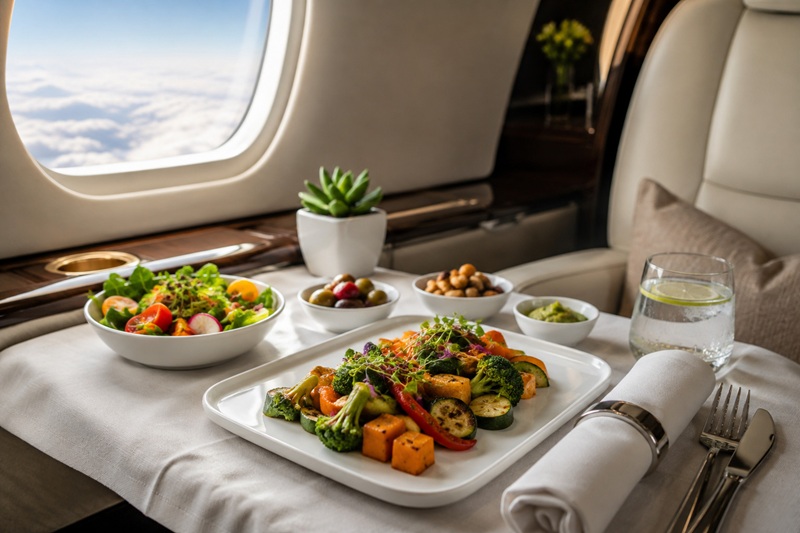
- A composed starter built on seasonal, locally sourced produce
- A protein-forward main built around legumes, ancient grains, or plant meat
- A dairy-free dessert built on fruit, nut butters, or plant-based chocolate
- A curated selection of vegan-certified wines, since not all wines qualify due to fining agents
For flight departments managing recurring vegan clients, this is the baseline, not the ceiling.
Sourcing Challenges Across Global Airports
Consistency is the hardest part of vegetarian and vegan catering across a global route network. A guest who accepts a specific brand of oat milk in London may reject the closest substitute in Riyadh, and a Jain principal in Singapore expects the same asafoetida-based seasoning a Mumbai kitchen would use by default.
Coverage varies sharply by region:
- North America and Western Europe: strong access to certified vegan proteins, plant-based dairy, and gluten-free bakery
- Middle East hubs: strong halal-certified vegetarian tradition, growing vegan availability at flagship hotels
- Sub-Saharan Africa and remote Pacific islands: limited access to specialty items such as vegan cheese, requiring pre-positioning
- India: unmatched vegetarian and Jain expertise in-country
- China and Japan: excellent tofu, seaweed, and mushroom-based ingredients, more limited Western-style vegan bakery
Operators moving between these regions should pre-load hard-to-source items on outbound legs when possible. A network of 2,800 vetted partners across 2,000 airports gives our desk the reach to compensate for regional gaps, drawing on Michelin-star kitchens, five-star hotels, and specialist vegan caterers on the same order. See our overview of smart inflight catering management for how this is coordinated globally.
Safety, Compliance, and Cross-Contact Discipline
Vegetarian and vegan service is a food safety discipline, not just a menu category. Cross-contact is the largest risk. Shared cutting boards, oil, or tweezers can render a technically vegan dish unacceptable to a strict guest, and medically unsafe for an allergic one.
HACCP-aligned catering inflight operations manage this through:
Segregated preparation zones for plant-based orders
Dedicated utensils, color-coded where possible
Documented ingredient sourcing with allergen and origin data
Sealed transit containers labeled with dietary code and passenger name
Cultural sensitivity adds another layer. A Jain principal avoids root vegetables and anything harvested by uprooting a plant. An observant Hindu guest may accept dairy but reject anything cooked in a kitchen that also handles beef. A sattvic protocol excludes onion, garlic, and mushrooms. Our reference on private jet catering rules and standards outlines the operational protocols behind this.
How We Deliver Vegetarian and Vegan Excellence
Our approach to plant-based service rests on three commitments. First, we brief every partner kitchen with the specific dietary protocol the passenger follows, not a generic vegan tag. Second, we source from within the destination market wherever possible, so a Kyoto departure carries shojin-style produce and a Marrakech departure carries argan oil and preserved lemon from the medina, not imported substitutes. Third, we run a 24/7/365 multilingual coordination desk, so a menu change requested from a Gulfstream on the ramp at 3 a.m. local time is executed before pushback.
Flight departments choose our inflight catering services because the network reaches 135 countries with the same standard applied at each airport, from major hubs to remote strips. For airport-level detail, our team maintains dedicated resources such as the LAX private jet catering page.
Conclusion
Vegetarian and vegan requests are now among the most common briefings received by premium catering desks in private aviation, and the guests behind them expect the same execution quality as any other cabin. The difference between a menu that lands and one that disappoints comes down to three practical choices: confirm the exact dietary framework before designing the menu, engineer altitude losses back into the food, and protect the plate from cross-contact at every step from kitchen to galley.
Flight departments looking to standardize this service across an international route network can reach the Dark Wing Inflight coordination desk directly. It operates around the clock and speaks the languages your ground handlers do. Call +44 204 577 0985, message on WhatsApp at +33 787 346 458, or write to info@darkwinginflight.catering to open an account or scope a specific trip.
Frequently Asked Questions
What is the difference between vegetarian and vegan inflight catering?
A vegetarian menu excludes meat, poultry, and often fish, but usually includes dairy, eggs, and honey. A vegan menu excludes every animal-derived ingredient, including hidden ones such as gelatine, isinglass in wine, and honey. On private jets, the distinction matters at ingredient sourcing, not just plating, and a vegan brief also covers wine fining agents, egg glazes on bakery, and cross-contact from shared surfaces.
How much notice does a private jet vegan menu require?
Standard vegetarian menus need around 24 hours at major hubs. Strict vegan, Jain, or sattvic menus benefit from 48 to 72 hours where specialty ingredients such as vegan-certified wine or asafoetida need pre-positioning. Shorter windows are possible, though ingredient variety narrows under tight lead times.
Can vegan menus be delivered at remote or challenging airports?
Yes. Availability varies by region, but pre-positioning and cross-network sourcing make full vegan service possible at almost any airport with fuel and handling. In remote Pacific, Sub-Saharan African, or Arctic destinations, specialty items are loaded on the outbound leg. A 2,800-partner network across 2,000 airports closes most gaps within the same trip.
How do you prevent cross-contact between meat and vegan dishes in the galley?
Vegan dishes are packed in sealed, dedicated containers labeled with dietary code and passenger name. Ground kitchens use segregated zones, dedicated utensils, and separate cooking oil. Cabin crew plate vegan courses first with dedicated tools. HACCP protocols document the chain from sourcing to galley delivery.
Are Michelin-star vegan menus available for private jet clients?
Yes. Several Michelin-star kitchens in our partner network specialize in plant-based tasting menus, and these can be commissioned for a specific flight leg. The menu is designed with altitude-aware seasoning, transit-ready structure, and full compliance with the guest's framework, from strict vegan to raw vegan or whole-food plant-based.