
A missed catering delivery rarely stays a catering problem. It becomes a delayed departure, an awkward call with a flight department, and a quiet note in a dispatcher's file about which handler to avoid. Fixed base operators compete on fuel pricing, hangar space, and ramp efficiency, yet the detail passengers remember most arrives in an insulated box twenty minutes before boarding.
This is why choosing a top rated airport catering service for FBOs has shifted from an afterthought to a core operational decision. This guide covers what separates leading providers from average suppliers, how to evaluate partners, and why food safety, global reach, and round the clock communication matter more in 2026 than ever.
Why Catering Quality Now Shapes FBO Reputation
Private aviation is running at record volume. According to WINGX year end activity data reported by GlobalAir, 2025 was the busiest year ever recorded for global business aviation, with flight sectors up 5 percent over the previous year. More departures mean more catering orders through FBO front desks, more crews comparing standards across locations, and more chances for a weak link to surface.
The dynamic is unforgiving for handlers. Catering is the most visible passenger facing element an FBO coordinates but does not produce in house. When a meal arrives late or at the wrong temperature, the principal rarely blames an unseen kitchen. The FBO absorbs the damage. Flight departments also review preferred handler lists yearly, and catering reliability now sits alongside fuel pricing and ramp safety in those reviews.
What Separates a Top Performer from an Average Supplier
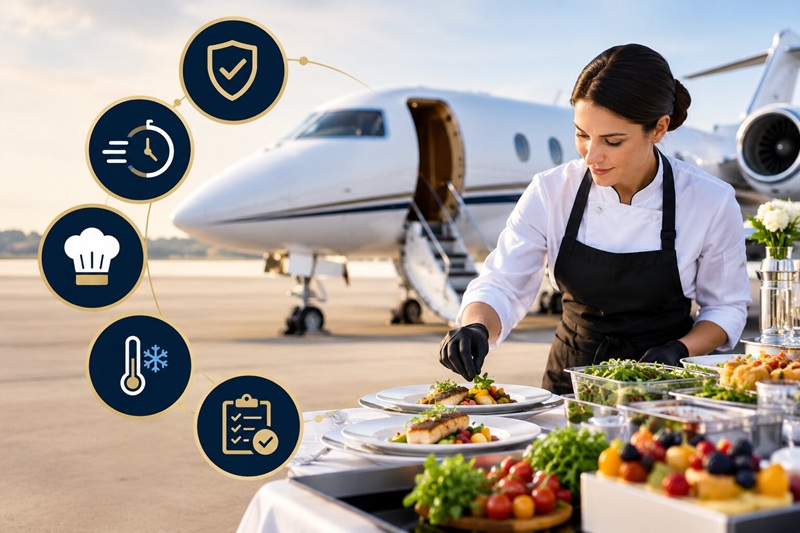
Four capabilities set leading providers apart. Each is operational, measurable, and visible within the first few orders.
Airside Access and Delivery Discipline
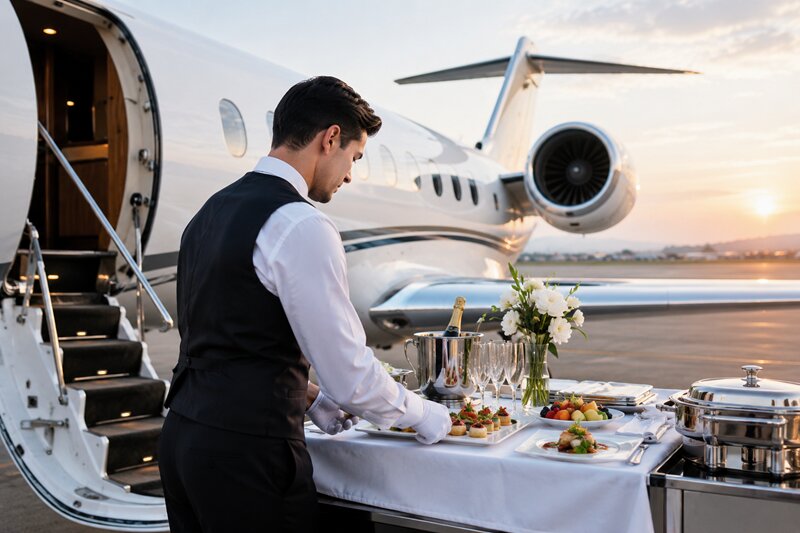
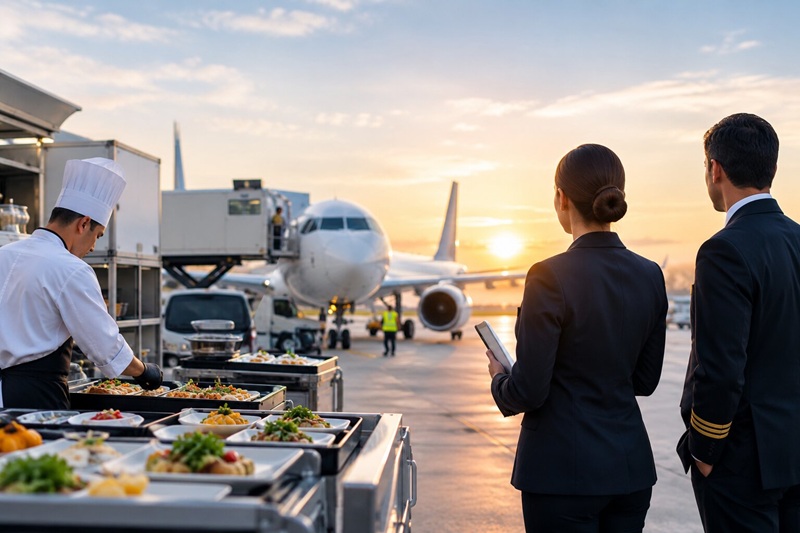
Premium kitchens are easy to find near major airports. Kitchens that can legally and reliably reach a stand are not. A capable partner holds current security badging, understands escort procedures at restricted fields, and runs temperature controlled vehicles with timed handovers. At busy hubs such as Teterboro, London Farnborough, Dubai Al Maktoum, and Paris Le Bourget, slot pressure leaves no room for a driver stuck at a gate. Discipline also means proof of delivery records, sealed packaging for VIP and government flights, and drivers trained for live ramps.
Food Safety That Survives an Audit
HACCP certification is the baseline, not the differentiator. The difference shows in execution: documented cold chain logs from kitchen to aircraft, allergen segregation, and labeling crews can verify at a glance. Handlers registered under the International Standard for Business Aircraft Handling published by IBAC increasingly expect supplier documentation to match their own audit trails. Galley ready packaging matters just as much, since food prepared for restaurant plating often fails at altitude. The practical side is explained in our guide to the rules of catering on private jets, which outlines how safe handling works from order to cabin service.
Menu Depth and Cultural Accuracy
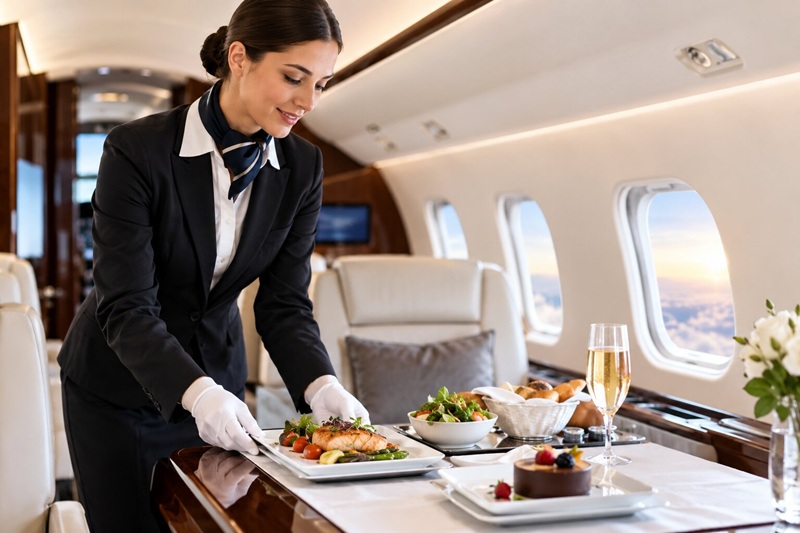
A leading provider cooks for the route, not just the departure city. That means certified halal preparation for a Riyadh bound flight, kosher supervision on request, Jain and vegan menus made without cross contact, and dishes engineered to reheat in a galley oven without losing texture. Coordinators handling international tails gain from a partner offering bespoke private jet meal options, since one menu card rarely satisfies a multi national passenger manifest.
Communication at Aviation Tempo
Tail swaps, slot changes, and passenger count revisions happen minutes before departure. An average supplier works business hours and answers tomorrow. A top performer runs a 24/7/365 operations desk, confirms every order in writing, and responds in minutes. Multilingual coordination matters too, since an FBO team in Sao Paulo, Lagos, or Hong Kong cannot lose an order to a language gap. Our breakdown of the smartest way to manage inflight catering shows how structured ordering workflows prevent most last minute failures.
How FBO Managers Should Evaluate a Catering Partner, Step by Step
Use this sequence when shortlisting suppliers. Each step exposes a specific failure mode before it reaches a client.
- Request certifications and audit history first. HACCP documentation, airport credentials, and liability insurance confirm the supplier can operate legally airside. Why it matters: paperwork gaps surface during incidents, the worst possible time.
- Place a live trial order at an inconvenient hour. A 3 a.m. request for a six passenger breakfast reveals true response times better than any sales pitch. Why it matters: private aviation keeps no office hours.
- Map coverage against your actual traffic. An airport catering company with genuine presence at the destinations your tails frequent prevents scrambling for unknown kitchens abroad. Why it matters: your clients fly internationally even when your FBO does not.
- Inspect packaging and galley compatibility. Ask for sample deliveries in the containers crews will handle, sized for galley chillers and ovens. Why it matters: fine food in the wrong packaging becomes a cabin problem at altitude.
- Stress test the recovery process. Ask what happens when a flight diverts or an order needs replacing within ninety minutes. Why it matters: a partner's truest measure is performance when the plan breaks.
- Confirm pricing transparency. Itemized quotes with delivery fees, airport charges, and packaging costs upfront prevent billing disputes. Why it matters: a surprise invoice damages trust faster than a late sandwich.
Where Quality Shows: Three Real World Scenarios
Consider a Gulfstream at Los Angeles International with departure pushed up two hours and two guests added. A strong partner reconfirms the count, adjusts quantities, and still delivers ahead of the new slot. Coverage details appear on our page for inflight catering at Los Angeles International Airport.
Now picture a repositioning flight from a secondary Caribbean airstrip with no commercial kitchen nearby. A networked provider sources from a vetted resort kitchen, applies the same cold chain controls, and documents the handover as it would in Geneva.
Finally, a government delegation crossing three capitals in four days needs sealed, security vetted deliveries at every stop, with menus adjusted for protocol and faith. Average suppliers decline this work. Leading ones have procedures for it.
The Operational Payoff for FBOs
Getting this right compounds quickly:
- Fewer departure delays tied to catering, protecting slot performance and crew duty windows.
- Stronger results in flight department audits, where catering reliability is a standing line item.
- Repeat tail visits, as dispatchers route aircraft toward handlers who make trips effortless.
- Less coordination time for CSRs, who stop chasing confirmations.
- An added revenue stream, as many FBOs earn margin on smoothly brokered catering.
How Dark Wing Inflight Supports FBO Teams
We work as an extension of FBO operations rather than a vendor at arm's length. Our network of more than 2,800 partners, spanning renowned restaurants, five star hotels, and Michelin star chefs, serves over 2,000 airports across 135 countries. A multilingual operations desk runs 24/7/365, so a coordinator in any time zone reaches a live specialist, not a voicemail. Every order moves under HACCP compliant handling with documented cold chain control, and menus are adapted for cultural and dietary needs as standard. FBO teams can review coverage and ordering procedures across our global inflight catering network before the next international tail arrives.
The Final Measure of a Catering Partner
The difference between a top rated provider and an ordinary one is rarely visible on a menu card. It shows in a badge that clears security without delay, a cold chain log that holds up in an audit, and a phone answered at 3 a.m. by someone who knows the tail number. FBOs that choose on these criteria spend less time firefighting and more time winning repeat traffic.
Dark Wing Inflight brings that standard to every stand we serve, from major hubs in North America and Europe to demanding fields across Asia, Africa, and Latin America. Research stage teams can request a coverage overview or sample menus for their busiest routes. Ready to order for an upcoming flight? Call +44 204 577 0985, reach us on WhatsApp at +33 787 346 458, or email info@darkwinginflight.catering, any hour, any day.
Frequently Asked Questions
What should an FBO look for in an inflight catering partner?
Prioritize four things: verified airside access, HACCP certified food safety with documented cold chain control, menu range covering dietary and cultural needs, and a 24/7 operations desk that confirms orders in writing. A partner strong in all four protects your turnarounds and reputation with flight departments.
How far in advance should catering be ordered for a private jet?
Standard orders are best placed 24 to 48 hours before departure, allowing proper sourcing, preparation, and airside scheduling. Experienced providers also handle short notice requests, often within four to six hours at major hubs, though complex menus and remote airports need earlier notice.
Can VIP catering be delivered at remote or secondary airports?
Yes, provided the caterer maintains a vetted local network. Leading providers source from approved hotel and restaurant kitchens near secondary fields across the Caribbean, Africa, and Southeast Asia, applying the same packaging and temperature controls used at primary hubs.
How is food safety maintained during airside delivery?
Through an unbroken cold chain. Meals travel in temperature controlled vehicles, sealed in tamper evident packaging, with time and temperature logged from kitchen to aircraft. Crews receive labeled, galley ready containers with reheating guidance, keeping HACCP compliance intact until cabin service.
Do airport caterers prepare halal, kosher, and other faith based meals?
Reputable providers do. Certified halal and supervised kosher preparation, plus Jain, vegan, and allergen controlled menus, come from specialist kitchens. For government and royal flights, faith requirements are confirmed at booking and documented on the delivery manifest.