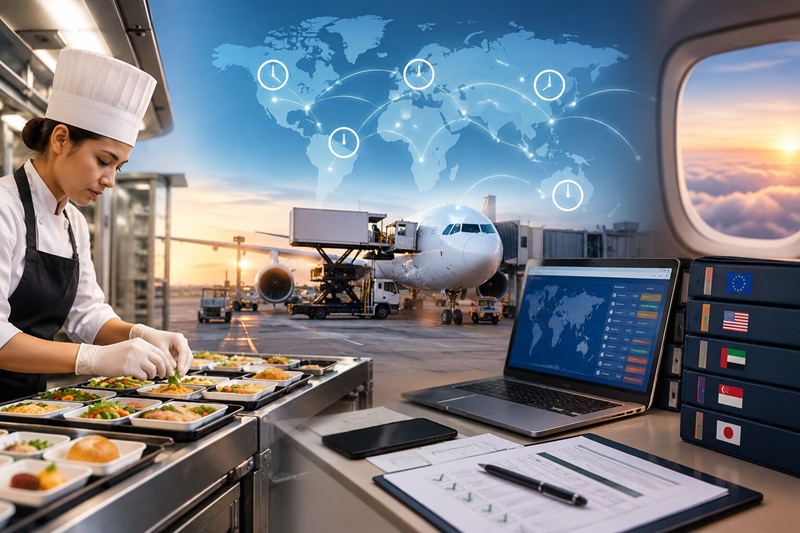
A government delegation lands at a secured airfield at 02:00. The crew needs 18 protocol-grade meals, two head of state menus, halal and kosher options, and a supplier the security office has already vetted. A commercial airline kitchen cannot handle this brief, and most local restaurants never will. State and defense missions sit at the hardest end of aviation catering, where food safety, confidentiality, and timing carry operational consequences rather than mere inconvenience. Demand keeps climbing as well. Honeywell's 2025 Global Business Aviation Outlook forecasts 8,500 new business jet deliveries worth 283 billion US dollars over the next decade, with 2026 deliveries expected to run about 5 percent above 2025 levels. More aircraft means more official movements, and more pressure on the small circle of caterers equipped to serve them. This guide maps that circle and shows you how to choose within it.
Why Government and Military Flight Catering Is Its Own Discipline
Leisure charter catering forgives small errors. A late dessert on a holiday flight earns an apology. A late uplift on a head of state movement can disrupt a diplomatic schedule, and a food safety lapse on a long military rotation can ground a crew. Providers serving this segment operate under tighter controls at every stage.
Security Vetting and Chain of Custody
Suppliers for official missions are screened before a single meal is prepared. Protection teams may inspect kitchens, request staff lists in advance, and mandate tamper-evident seals on every container. Each handover from kitchen to vehicle to aircraft galley is documented, so the delegation knows exactly who touched the food and when. Certain missions also require retention samples held for 48 to 72 hours after service.
Protocol, Confidentiality, and Cultural Accuracy
Routings, passenger identities, and schedules on these flights are sensitive or classified. Leading caterers work under strict non-disclosure agreements, train staff on discretion, and often operate from coded flight references instead of names. Cultural precision matters just as much. A state menu must respect religious dietary law, national customs, and seniority-based service order without a single misstep, because the meal itself is part of the diplomacy.
What the Best Providers Get Right
Across the segment, the leaders share a recognizable operating pattern:
- Global reach with local execution: coverage spanning civilian gateways such as London Luton, Washington Dulles, Geneva, Abu Dhabi, and Singapore Changi, plus remote or austere airfields across Africa, Central Asia, and the Pacific.
- 24/7/365 operations desks: official movements change at short notice, so order desks must answer at 03:00 on a public holiday with the same response time as midweek.
- HACCP-certified kitchens: documented cold chain control from preparation through to the aircraft galley, with temperature logs available on request.
- Multilingual coordination: delegations, embassies, and flight crews rarely share one working language, and ordering errors born of translation are unacceptable here.
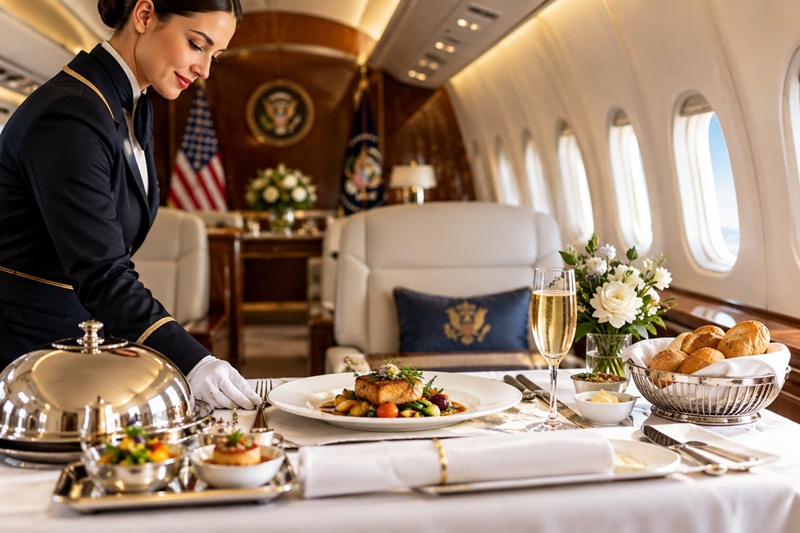
- Diet and protocol fluency: halal and kosher certification, allergen isolation, vegetarian state banquets, and VVIP presentation standards handled as routine rather than exception.
The Provider Landscape in 2026
The IMARC inflight catering market analysis values the global sector at 16.5 billion US dollars in 2025, with annual growth above 5 percent projected through 2034. Within that market, only a narrow band of inflight catering companies is structured for government and military work. They fall into four types:
Specialist VIP catering networks. Built around private and official aviation, these providers coordinate vetted restaurants, hotel kitchens, and dedicated flight kitchens across hundreds of airports. Strongest for multi-country missions and short-notice changes.
Airline-affiliated flight kitchens. Industrial caterers excel at volume for troop charters, but bespoke protocol menus and odd-hour flexibility at smaller fields sit outside their design.
FBO-based caterers. Kitchens attached to fixed-base operators deliver well at their home airport yet offer little once the mission moves beyond it.
Defense contract caterers. Firms holding standing government frameworks for logistics and troop movements. Engineered for scale and compliance rather than VVIP presentation.
Most sustained state and defense programs end up blending a global network for coordination with strong local kitchens for execution, which is why coverage depth matters more than any single brand name.
How to Evaluate a Catering Partner for State and Defense Missions
Six checks separate a reliable partner from an expensive risk:
- Confirm airport and country coverage first. A provider covering 90 percent of your routing still leaves you sourcing an unvetted kitchen for the remaining stop, which defeats the purpose of vetting at all.
- Audit food safety documentation. Request HACCP certification, cold chain procedures, and allergen protocols in writing. A credible operator produces these within hours, not days.
- Test the response window. Place a trial inquiry at an inconvenient hour. The speed and quality of that first reply predicts how an AOG-style catering emergency will be handled later.
- Review security handling. Non-disclosure agreements, staff vetting, sealed transport, and airside access credentials should already exist as standard procedure, not be assembled for your inquiry.
- Probe cultural and dietary depth. Ask for sample menus for a halal state dinner or a kosher crew rotation. Generic answers here reveal a supplier who will improvise under pressure.
- Clarify billing and contracting. Government procurement needs transparent quotes, multi-currency invoicing, and framework agreement options before the first order, not after it.
Flight departments that brief suppliers accurately get better results, so it helps to understand the rules of catering on private jets before issuing a request, since official flights inherit most of those operational constraints and add their own.
A Network Built for Official Missions
Dark Wing Inflight serves government, military, and VIP private jet missions through a global VIP inflight catering network of 2,800+ partners, including Michelin-star chefs, five-star hotels, and specialist flight kitchens across 2,000+ airports in 135 countries. Operations desks run 24/7/365 in multiple languages, every kitchen in the network works to HACCP standards, and protocol teams prepare bespoke meal options for heads of state, defense delegations, and crew rotations alike. The same structure covers a G650 positioning through Geneva and a military transport staging through the Gulf, which removes the need to re-vet suppliers at every new destination.
Budget, Lead Times, and Remote Destinations
Standard orders are confirmed within 24 hours. State menus, certified religious meals, and remote airfields in Central Asia, West Africa, or the Pacific islands deserve 48 to 72 hours, since ingredients and vetted drivers may need positioning. Cost is driven by passenger count, menu tier, airport handling fees, and delivery complexity rather than distance alone. Multi-leg missions benefit from a single coordinating desk, and there are proven ways of managing inflight catering across multiple legs that cut both waste and invoice disputes.
Conclusion
Choosing a caterer for state and defense aviation is a risk decision before it is a food decision. The right partner proves coverage across your actual routing, documents its HACCP and security procedures without prompting, answers at 03:00, and treats cultural precision as non-negotiable. Apply the six checks above to any shortlist and the weak candidates remove themselves quickly. If you are researching options, start by reviewing airport coverage and sample menus for your typical routes. If a mission is already on the calendar, Dark Wing Inflight's operations team responds around the clock: call +44 204 577 0985, message +33 787 346 458 on WhatsApp, or email info@darkwinginflight.catering with your routing, passenger count, and dietary requirements, and a coordinator will return a vetted quote for every stop on the schedule.
Frequently Asked Questions
What is the difference between VIP and government inflight catering?
The food standard is similar, the controls are not. Government and military catering adds supplier vetting, documented chain of custody, tamper-evident packaging, retention samples, and confidentiality agreements on top of VIP presentation. Timing tolerances are tighter, because official schedules rarely move for a late delivery.
How far in advance should catering for a government flight be ordered?
Order 24 hours ahead for standard uplifts at major airports, and 48 to 72 hours for state menus, certified halal or kosher meals, or remote airfields. A 24/7 provider can still execute same-day changes at busy hubs such as Geneva, Dubai, or Washington, but earlier notice protects menu quality, presentation, and the time needed for security checks on both food and delivery staff.
Do military flight caterers need security clearance?
Formal national clearances are rarely mandatory for the caterer itself, but vetting is. Protection teams typically require staff identity checks, kitchen inspections, sealed transport, and non-disclosure agreements before approving a supplier. Providers already holding these procedures shorten approval from weeks to days.
Which destinations are hardest to cater for official flights?
Austere military airfields, island states with thin supply chains, and airports with restricted airside access rank highest. Parts of Central Asia, the Sahel, and the Pacific demand ingredient positioning a day or more in advance. A provider with established local partners in 135 countries handles these stops without improvisation.
How much does government and military inflight catering cost?
Expect crew meals to price far below protocol menus, with head of state service at the top of the range. The main cost drivers are menu tier, passenger count, airport fees, and delivery logistics rather than flight distance. Reputable providers quote transparently per order, invoice in multiple currencies, and support framework agreements for recurring missions, which keeps procurement teams audit-ready.