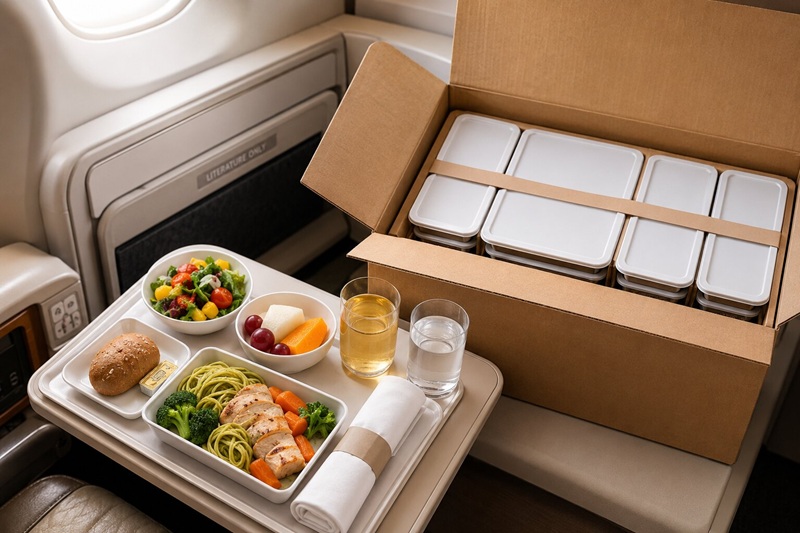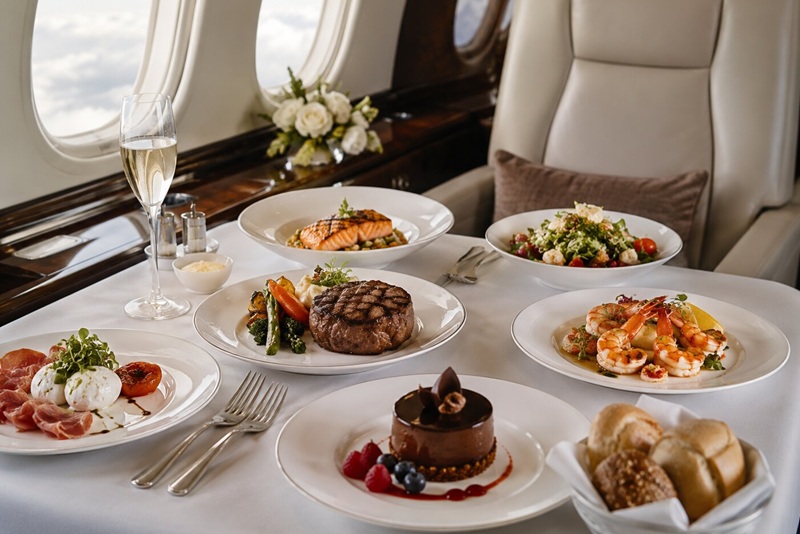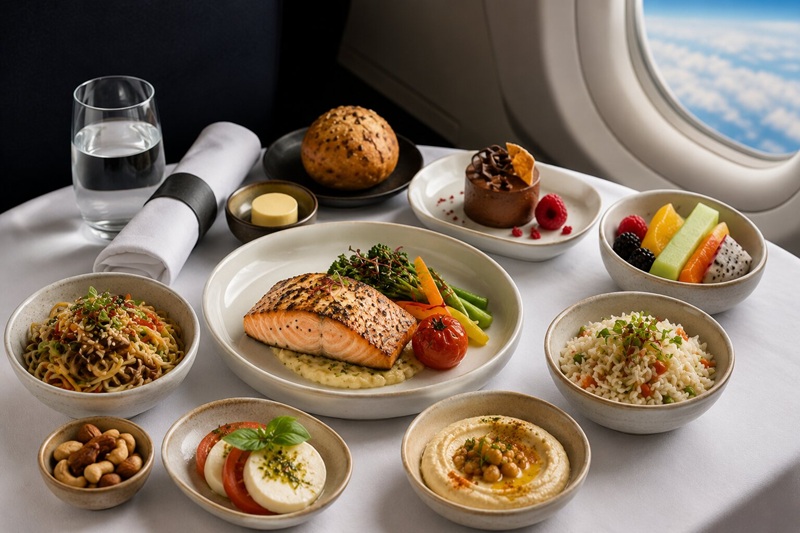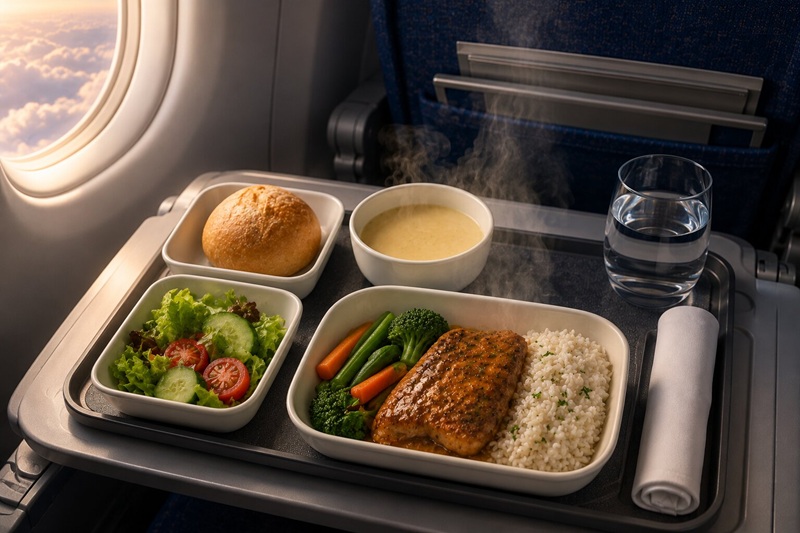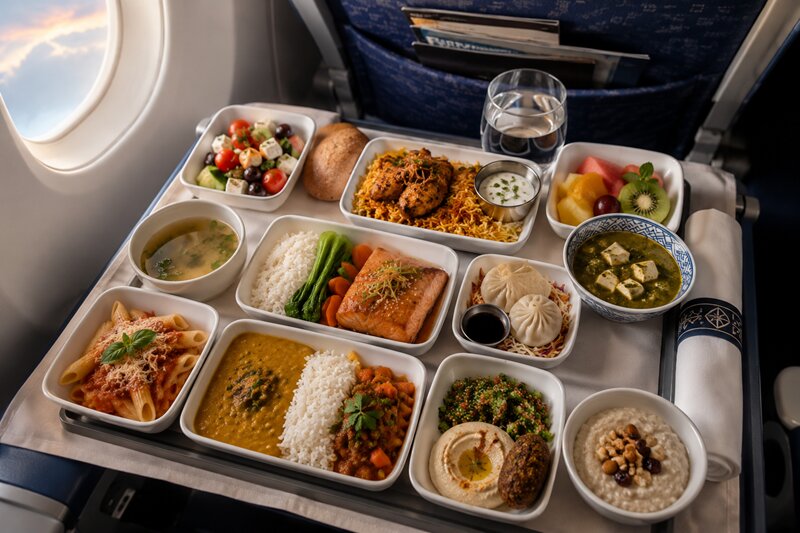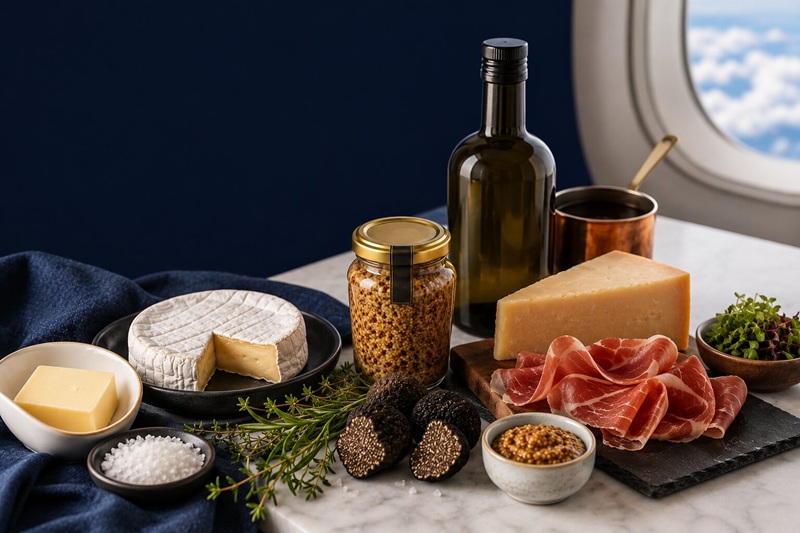
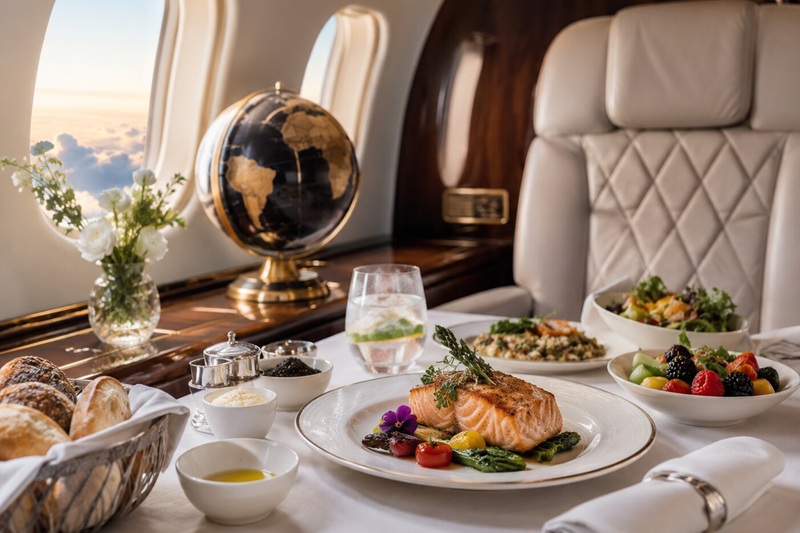
An international flight reshapes every assumption about catering. The same passenger who orders a simple Cobb salad on a domestic hop may expect a multi-course Asian breakfast on the return leg from Singapore. The same meal that traveled flawlessly from London to Madrid may struggle on a longer route from Madrid to Sao Paulo. The variables multiply with distance, time, regulation, and culture. According to the IATA 2026 global industry forecast, global passenger volumes are projected to reach 5.2 billion in 2026, with continued growth in private aviation reflecting demand for personalized, long-haul travel. For flight departments and operators, that growth makes international catering planning a higher-stakes exercise than ever. This article focuses on the considerations that actually drive outcomes, beyond surface-level menu choices, when arranging catering for international private flights.
Aircraft and Route Considerations
The aircraft itself is the first variable to weigh. A Gulfstream G700 or Bombardier Global 7500 with a full forward galley supports multi-course meals prepared and finished in flight. A midsize jet with a smaller galley may only accommodate cold platters and pre-prepared items that need a single reheat cycle. The route adds another layer. A transatlantic flight crosses time zones and meal windows, requiring breakfast, lunch, and a snack service across the same flight. A Gulf-to-Asia route may include a passenger profile that expects entirely different cuisines on departure and arrival. Catering planners should match the menu structure to both the galley capability and the route profile. Overdesigning a menu that the galley cannot execute is one of the most common reasons international service falls short of expectations.
Time Zone Shifts and Meal Timing
Time zones quietly drive how passengers experience inflight meals. A flight departing Hong Kong at 11 p.m. lands in London at 5 a.m. local time but at 1 p.m. body time for many passengers. The service rhythm should reflect this, not the departure city clock. Skilled catering teams plan meal sequences for the destination time zone where possible, gradually shifting service to help passengers adjust circadian rhythms before arrival. This is especially valuable for executives flying for important meetings. Breakfast served close to landing helps reset the body. A heavy late-night dinner can leave a passenger disoriented for hours. For long-haul international flights, asking the passenger about their preferred sleep and work pattern during the flight is often more important than asking about menu preferences.
Cabin Environment and Altitude Effects
International flights typically involve longer time at cruising altitude, which compounds the effects of low cabin humidity and reduced pressure on flavor perception. Dishes that perform well at ground level can taste flat after several hours in the galley. Caterers planning long-haul international menus should bias toward bolder umami and seasoning profiles, sauces that retain moisture, and ingredients that survive multiple service cycles. Hydration also becomes a bigger consideration. Salty preparations, alcohol, and rich foods accelerate dehydration on a 10-hour flight in a way they would not on a short domestic hop. Including hydrating options (fresh fruit, light soups, infused waters) across the service rounds helps passengers arrive in better shape, regardless of how refined the main courses were.
Multi-Cultural Passenger Groups
Many international private flights carry mixed delegations. A government flight might include officials from three nationalities. A corporate trip might bring together executives from different regional offices. A family flight may span generations with different food preferences and dietary backgrounds. A single menu rarely satisfies a mixed group. The strongest approach is to design parallel service tracks that respect each passenger's profile while sharing visual and timing elements that keep the cabin coherent. This requires deep cultural literacy: knowing not just what halal or kosher means in principle, but how a specific delegation expects those certifications to be applied, presented, and served. Generic labels are not the same as understood preparation. Operators planning international flights with mixed passenger groups should verify both the dietary specifications and the presentation expectations in advance.
Cost Considerations Across Regions
Pricing for international flight catering varies more than most flight departments expect. Ingredient costs, labor rates, regulatory compliance overhead, customs fees, and last-minute sourcing premiums all swing significantly by region. A bespoke menu prepared in Geneva or Monaco can cost two to three times the same menu prepared in Lisbon or Athens. Departure airports with limited local supply networks tend to carry higher costs because rare ingredients must be imported. Last-minute orders also incur premium charges due to the logistical effort required. Coordinators planning international flights should request transparent pricing with line items for sourcing, preparation, packaging, and delivery rather than a single bundled quote. This makes it easier to compare options across regions and identify where flexibility on menu choices can reduce costs without compromising the passenger experience.
Sustainability and Local Sourcing on International Routes
Sustainability is now a defining factor in international catering decisions, not an optional extra. Passengers increasingly ask how ingredients were sourced, how packaging is handled, and whether food waste is being managed responsibly across the supply chain. Local sourcing at the departure airport reduces transportation emissions and supports regional economies, but it also requires deeper relationships with vetted local suppliers in each city. Dark Wing Inflight's coverage of sustainable VIP catering practices explores how progressive operators are integrating regionally sourced ingredients, reusable packaging, and reverse logistics across their networks. For international flights, sustainability planning is not just an ethical choice. It is also operationally smart, since locally sourced ingredients face fewer customs barriers and arrive at the catering facility on shorter timelines.
Choosing the Right Catering Partner for International Routes
The single most important consideration for international flights is the catering partner itself. A provider with a strong domestic operation may still struggle with the cross-border coordination, multilingual support, and local sourcing depth that international flights require. The best catering services for private jets operating internationally share a few traits: a global partner network with vetted local relationships at major airports, 24/7 multilingual coordination, documented compliance with international food safety standards, and the operational flexibility to absorb last-minute changes. Five-star private jet service operations require this depth across every leg of an international trip, not just at the home base. Working with a partner who has operated at the destination airport before is consistently more reliable than working with one who is figuring it out for the first time.
Conclusion
Catering an international private flight is an exercise in weighing variables that domestic flights rarely surface. Aircraft galley capability, route profile, time zones, altitude effects, multi-cultural passenger groups, regional costs, sustainability concerns, and partner depth all influence the outcome. The flight departments and operators who treat these as connected considerations rather than separate boxes consistently deliver a smoother experience for passengers. Those who treat international catering as an extension of domestic catering with longer paperwork tend to run into avoidable problems. The decision that affects everything else is the choice of catering partner. A provider with deep local networks, multilingual coordination, regulatory fluency, and operational flexibility can absorb the complexity of international flight planning so that flight departments and passengers experience it as effortless. Dark Wing Inflight has built its operation around exactly this profile, supporting international private aviation across 135 countries with a single coordinated relationship.
Frequently Asked Questions
How does international flight catering differ from domestic catering?
International catering involves regulatory compliance across multiple countries, longer cold-chain transport, customs and agricultural declarations, multilingual coordination, and often very different cuisine expectations between departure and destination. Time zones, flight duration, and altitude effects all extend the planning horizon. A simple cold platter for a one-hour domestic flight may take 12 hours to plan, while a bespoke multi-course meal for an eight-hour international flight can require 72 hours or more. The food itself may be the visible product, but the logistical and regulatory work surrounding it is what determines whether the meal arrives as intended. Working with a globally networked catering provider is the most reliable way to manage these differences without errors.
What aircraft galley type is needed for full international meal service?
Large-cabin and ultra-long-range aircraft such as the Gulfstream G650, G700, G800, Bombardier Global 7500, and Falcon 10X support full galley operations with convection ovens, chillers, espresso machines, and dedicated prep areas. These aircraft can accommodate multi-course meals prepared and finished in flight. Midsize jets and super-midsize jets typically support hot meal service via single-cycle reheating but may not support complex preparation in flight. Light jets and very light jets generally accommodate cold platters and pre-prepared items only. Knowing the galley configuration in advance is essential because designing a menu the aircraft cannot execute is one of the most common reasons international service falls short.
How are dietary restrictions handled on international private flights?
Dietary restrictions on international flights require verification rather than assumption. For halal, kosher, vegan, gluten-free, or allergen-specific meals, the caterer should provide written certification from recognized authorities and document the supply chain. Cross-contamination prevention becomes especially important on long-haul flights where multiple meal types are prepared in the same kitchen. For severe allergies, request a fully allergen-free flight environment in writing. International routes also raise the question of religious calendars: Ramadan, Yom Kippur, and other observances affect what passengers will or will not eat at specific times. Confirming these details well before departure is far more reliable than addressing them at the last minute.
Should catering be sourced at the departure city or at the destination?
Departure-city sourcing is almost always preferred for outbound legs because it allows the catering team to prepare, package, and deliver under controlled conditions before takeoff. For return legs or multi-stop trips, sourcing from each departure point in turn provides freshness and local authenticity. Operators with global networks coordinate this seamlessly across each leg of an international trip, allowing passengers to enjoy regionally appropriate cuisine while maintaining consistent service standards. Sourcing only from a single home base for a multi-leg international trip rarely works well, since freshness, customs restrictions, and local preferences all favor regional sourcing where possible.
How important is multilingual coordination for international catering?
Multilingual coordination is one of the most underrated factors in international catering success. A request placed in English with a French supplier, a Japanese ground handler, and an Italian cabin crew creates multiple translation gaps where details can be lost. Catering partners with native-language coordinators in major markets reduce this risk substantially. The best providers operate around the clock with multilingual teams who can confirm details directly with each link in the supply chain. Dark Wing Inflight's 24/7/365 multilingual coordination across 135 countries was built specifically for this reason: international flights cannot wait for business hours, and language gaps cannot be allowed to delay a tarmac handoff.