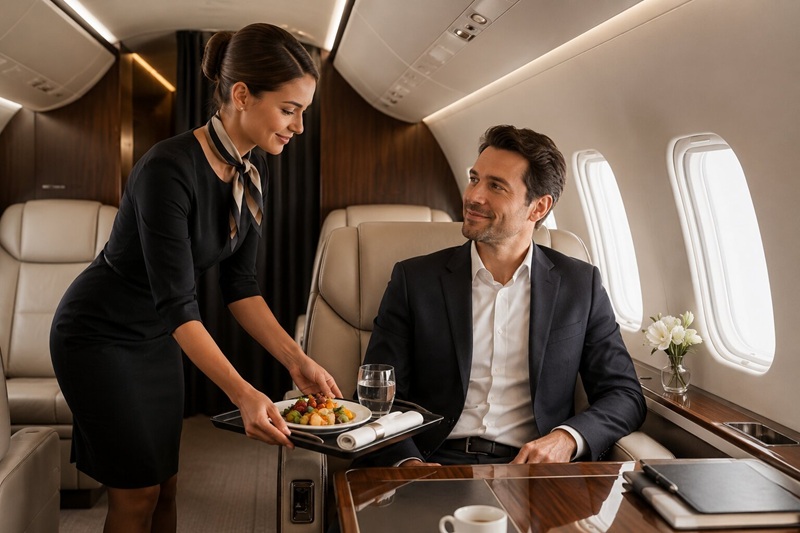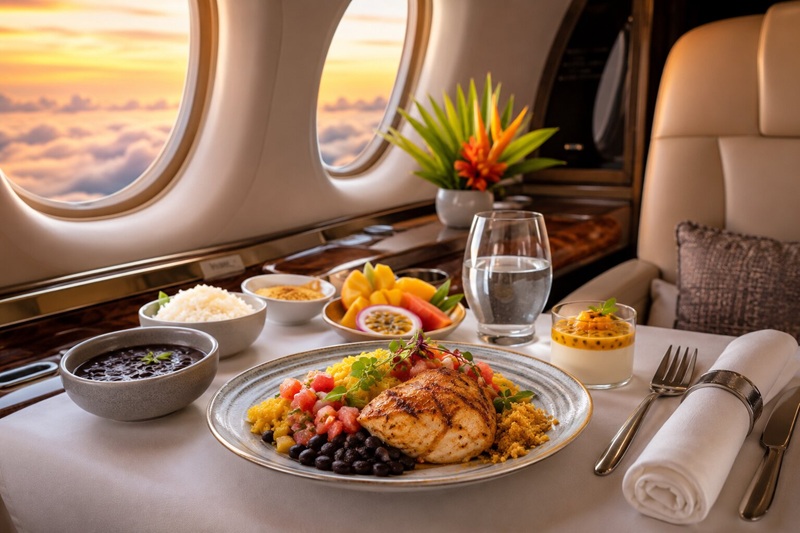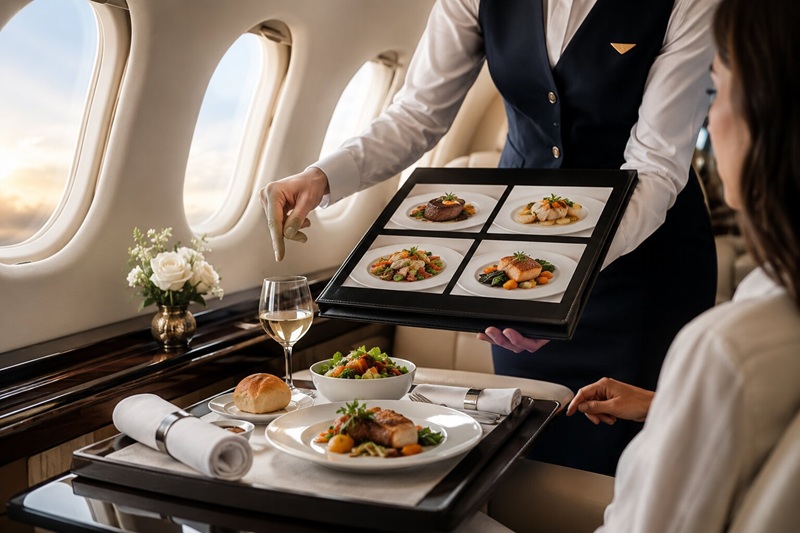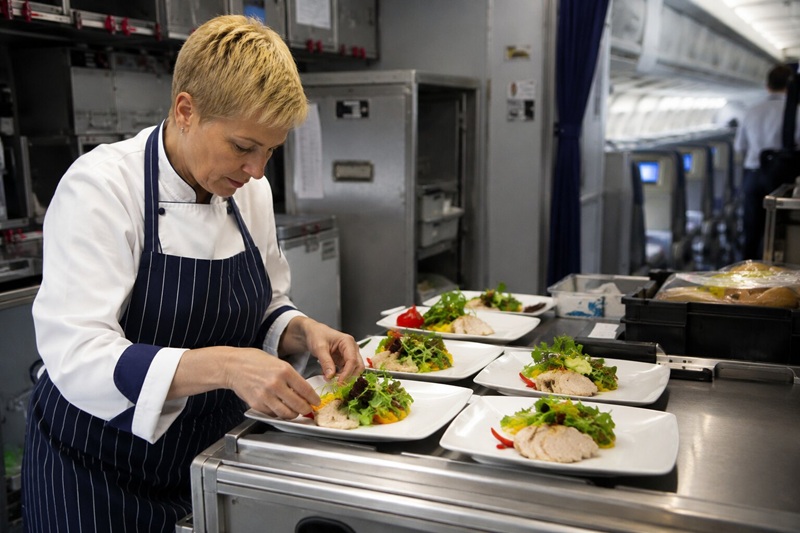
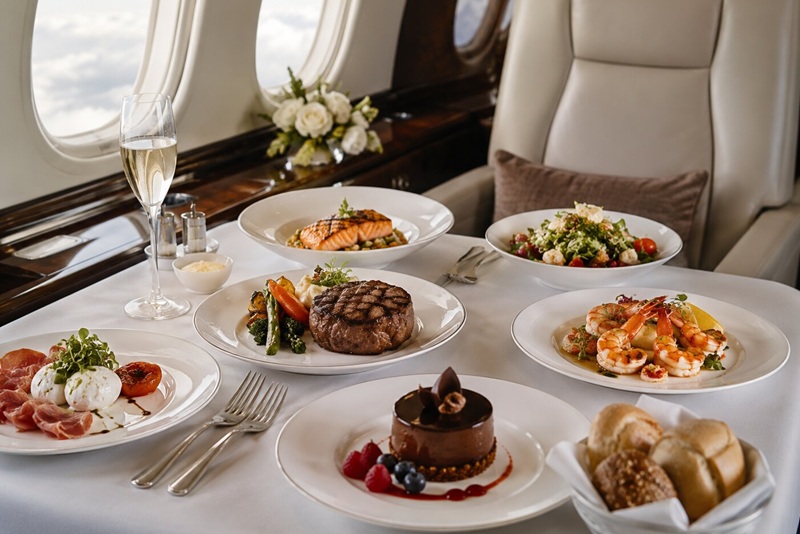
Dining at 40,000 feet on a private aircraft is nothing like the reheated trays served on commercial flights. Passengers aboard business jets and ultra-long-range aircraft expect meals that match the precision of a fine restaurant, prepared by trained chefs and delivered to the cabin with impeccable timing. According to Mordor Intelligence's inflight catering market analysis, the global inflight catering market is forecast to reach USD 18.77 billion in 2026, and private aviation accounts for a growing share of that demand. What do these passengers actually order? The answer may surprise you. Alongside caviar and champagne, the most frequently requested dishes tend to be refined versions of familiar favorites, prepared with premium ingredients and adapted for altitude. This guide breaks down the seven most popular dishes ordered on board private jets, why they work so well above the clouds, and what goes into preparing each one for service at cruising altitude.
Why Food Tastes Different at Altitude
Before exploring the dishes, it helps to understand why altitude changes the dining equation. Cabin pressure at cruising altitude reduces humidity to roughly 12%, which dulls the palate and weakens perception of salt and sweetness. The noise environment further suppresses flavor sensitivity. Experienced private jet catering teams account for this by adjusting seasoning profiles, selecting ingredients with naturally bold flavors, and choosing dishes that retain texture and moisture even after reheating in a galley. The best inflight meals are not simply good restaurant dishes placed on a tray. They are engineered for the cabin environment, balancing flavor intensity, visual presentation, and practical reheating logistics. That is what separates a forgettable onboard meal from one that passengers remember long after landing.
The 7 Most Requested Dishes on Private Jets
1. Seared Filet Mignon with Truffle Jus
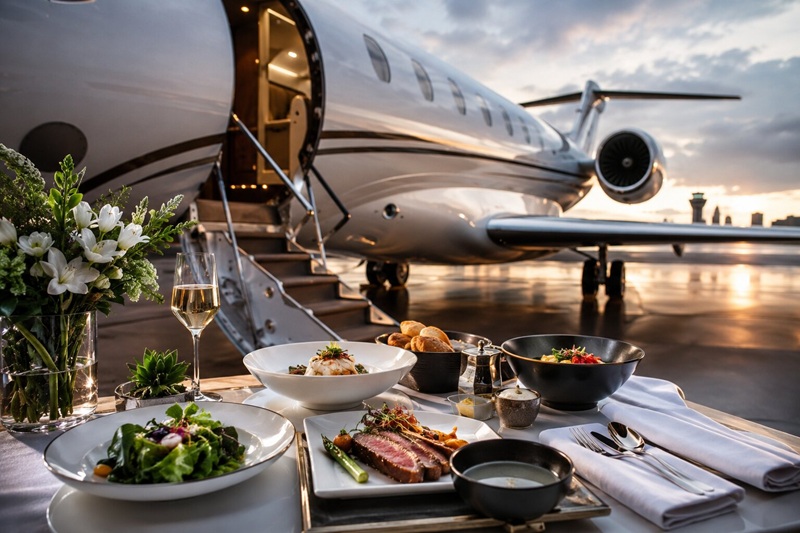
Filet mignon is consistently the most ordered main course on private jets worldwide. The cut holds up exceptionally well during inflight reheating because its high fat-to-lean ratio preserves moisture. Passengers typically request it medium-rare, paired with roasted root vegetables or a potato gratin. Truffle jus adds a layer of umami that cuts through the altitude-induced dullness of the palate. For longer flights departing from Europe or the Middle East, many caterers source grass-fed tenderloin or Wagyu-grade beef to meet client expectations. The dish plates beautifully, travels well, and satisfies passengers who want a substantial, familiar centerpiece to their meal.
2. Freshly Prepared Sushi and Sashimi Platters
Sushi ranks among the top three requests globally, particularly on routes through Asia, the West Coast of the United States, and the Middle East. Quality is non-negotiable. Passengers expect sashimi-grade tuna, yellowtail, and salmon sourced that morning, along with properly seasoned rice and authentic accompaniments like wasabi, pickled ginger, and premium soy. Timing is critical with sushi. It must be prepared as close to departure as possible and kept at precise temperatures during transit to the aircraft. For clients arranging private jet catering Los Angeles departures, West Coast caterers often work with local fish markets to ensure the catch reaches the aircraft within hours of being landed. Sushi also works well as a shared platter for group travel, making it a versatile choice across aircraft sizes.
3. Lobster Thermidor or Butter-Poached Lobster Tail
Lobster has long been associated with luxury inflight dining, and it remains one of the most frequently ordered seafood dishes on private jets. Lobster Thermidor, with its rich cream and mustard sauce, reheats better than many seafood preparations because the sauce protects the delicate flesh from drying out. Butter-poached lobster tail is another popular variation, especially for passengers who prefer a cleaner presentation. Dark Wing Inflight sources lobster through its network of 2,800+ restaurant and VIP catering partners across 2,000+ airports, ensuring consistent quality even for departures from remote or less common destinations in Africa, Central Asia, or the South Pacific.
4. Artisanal Cheese and Charcuterie Boards
Not every inflight meal needs to be a hot entree. Artisanal cheese and charcuterie boards are among the most popular pre-departure and mid-flight requests, especially on shorter European or domestic routes. Passengers appreciate curated selections that include aged Comte, triple-cream Brie, Manchego, thinly sliced prosciutto di Parma, bresaola, and accompaniments like fig preserves, honeycomb, and cornichons. These boards require zero reheating, which makes them ideal for light jets and very light jets that lack full galley equipment. They also pair naturally with champagne and fine wines, setting the tone for a relaxed flight. Regional sourcing is part of the appeal. Passengers departing from Paris, Milan, or Geneva often request locally produced cheeses and cured meats that reflect the character of their departure city.
5. Grilled Mediterranean Sea Bass
Health-conscious travelers have driven a noticeable shift toward lighter, protein-rich mains on private jets. Grilled sea bass, prepared Mediterranean-style with olive oil, capers, lemon, and fresh herbs, has become one of the most requested fish dishes. It aligns with a broader wellness-focused dining trend reshaping luxury travel in 2025 and 2026. Sea bass holds its texture well during reheating and delivers a clean, bright flavor profile that satisfies without heaviness. It pairs well with grilled vegetables, quinoa, or a simple arugula salad. Passengers traveling through Southern Europe, the Eastern Mediterranean, or North Africa frequently request regional variations of this dish, including whole grilled branzino served tableside on larger aircraft.
6. Eggs Benedict with Smoked Salmon
Breakfast service on private jets deserves its own category, and Eggs Benedict with smoked salmon is far and away the most ordered morning dish. The combination of poached eggs, silky hollandaise, high-quality smoked salmon, and a toasted English muffin delivers richness without feeling heavy. The dish does present a logistical challenge: hollandaise sauce is notoriously difficult to hold and reheat. Skilled aviation caterers prepare the components separately and assemble them just before plating in the cabin. For early-morning departures, when passengers board before sunrise and expect a polished meal within minutes of reaching cruising altitude, preparation timing is everything. This dish exemplifies why experienced onboard catering teams make a measurable difference in passenger satisfaction.
7. Handmade Pasta with Seasonal Ingredients
Pasta is universally loved and remarkably adaptable for inflight service. Handmade tagliatelle with black truffle and Parmigiano-Reggiano, lobster linguine, or a simple cacio e pepe are all regular requests. Pasta reheats efficiently, and its sauces can be calibrated for altitude by increasing seasoning intensity slightly beyond what a ground-level restaurant would use. Italian-inspired dishes remain a staple on transcontinental and ultra-long-range routes. Passengers heading to or from Italy, the Middle East, or Latin America often request pasta as a comforting main or second course. The dish is also practical for families and group charters, as it can be scaled easily and tailored to dietary preferences, including gluten-free and vegan variations.
What Shapes Menu Choices on Private Jets
Several factors influence what passengers order, and understanding them helps flight departments plan more effectively.
• Flight duration: Short hops call for cold platters and light bites. Flights over four hours typically require a full hot meal service with multiple courses.
• Aircraft galley size: Very light jets may only accommodate cold items and pre-packaged snacks. Large-cabin and ultra-long-range jets support full galley operations with oven, chiller, and sometimes a dedicated onboard chef.
• Cultural and dietary requirements: Halal, kosher, vegan, and allergen-free menus are standard requests in global private aviation. A catering partner with multilingual support and deep regional expertise is essential for handling these needs across different countries.
• Time zone and meal timing: Departure time relative to the destination time zone determines whether passengers expect breakfast, lunch, or dinner service, regardless of local clock time at the origin airport.
• Passenger profile: Corporate executives on a working flight may prefer lighter, energy-sustaining meals. Leisure travelers or families might opt for more elaborate multi-course dining.
Dark Wing Inflight manages these variables across 135 countries with 24/7/365 multilingual coordination, connecting flight departments with Michelin-star chefs, five-star hotel kitchens, and vetted local caterers at over 2,000 airports worldwide.
Conclusion
The most popular dishes on private jets share a few things in common: they use premium ingredients, they are designed to perform well at altitude, and they reflect the personal tastes of the passengers rather than a fixed menu. From a perfectly seared filet mignon to a hand-rolled sushi platter prepared hours before departure, inflight dining in private aviation is defined by customization and culinary precision. As the private jet charter market grows toward a projected USD 45.43 billion by 2030 according to a Research and Markets industry forecast, demand for exceptional onboard dining will only intensify. Flight departments, charter operators, and passengers who invest in the right catering partnership gain more than great food. They gain consistency, global reach, and the confidence that every meal served at 40,000 feet reflects the same standard they expect on the ground. For catering support at any airport worldwide, reach out to the Dark Wing Inflight team to discuss your next flight.
Frequently Asked Questions
What types of food can you order on a private jet?
Private jet passengers can order virtually any cuisine or dish, from multi-course fine dining to simple comfort food. Menus are fully customizable based on passenger preferences, dietary needs, and cultural requirements. Common categories include hot entrees like filet mignon and lobster, cold platters such as sushi and charcuterie, breakfast items like Eggs Benedict, and desserts ranging from handcrafted pastries to artisanal chocolates. The only real constraint is the galley equipment available on the specific aircraft and the preparation lead time provided to the catering team.
How far in advance should I place a catering order for a private jet?
For standard menus, 24 to 48 hours of lead time is typically sufficient. Complex requests, such as sourcing specific ingredients, arranging a multi-course tasting menu, or coordinating with a Michelin-star chef, may require 72 hours or more. That said, experienced global catering providers maintain rapid-response capabilities for last-minute orders and schedule changes. Dark Wing Inflight operates around the clock and can accommodate urgent catering requests across its global network of 2,800+ partners.
Can inflight catering for private jets accommodate halal, kosher, and vegan dietary requirements?
Yes. Reputable inflight catering providers routinely handle halal, kosher, vegan, gluten-free, allergen-specific, and medically prescribed dietary requirements. The key is working with a provider who has access to certified kitchens and suppliers in the departure region. For international routes crossing multiple cultural zones, this capability becomes especially important. Providers with deep global networks can source certified meals even at airports where options might otherwise be limited.
Why does food taste different on a private jet compared to eating on the ground?
At cruising altitude, reduced cabin pressure and low humidity diminish the sensitivity of taste buds, particularly for salt and sweet flavors. Background engine noise can further suppress flavor perception. Professional inflight caterers compensate by adjusting seasoning profiles, selecting naturally flavorful ingredients, and choosing dishes that retain moisture and texture during reheating. This is why altitude-optimized menu planning is an important part of the private jet dining experience.
What is the average cost of catering for a private jet flight?
Costs vary widely depending on the number of passengers, the complexity of the menu, the departure location, and lead time. A simple cold platter for two passengers on a short flight may start at a few hundred dollars, while a full fine-dining experience with premium ingredients for a large group on an ultra-long-range aircraft can run into several thousand. The best approach is to request a tailored quote from your catering provider based on the specific flight details and passenger preferences.