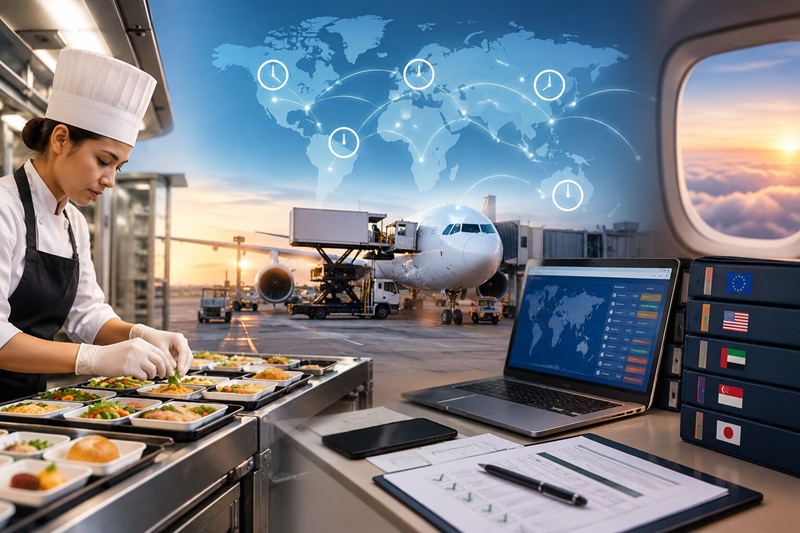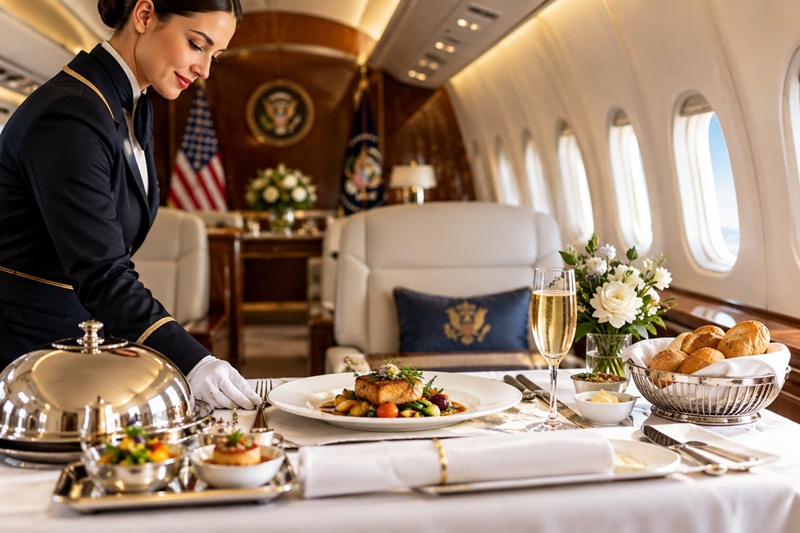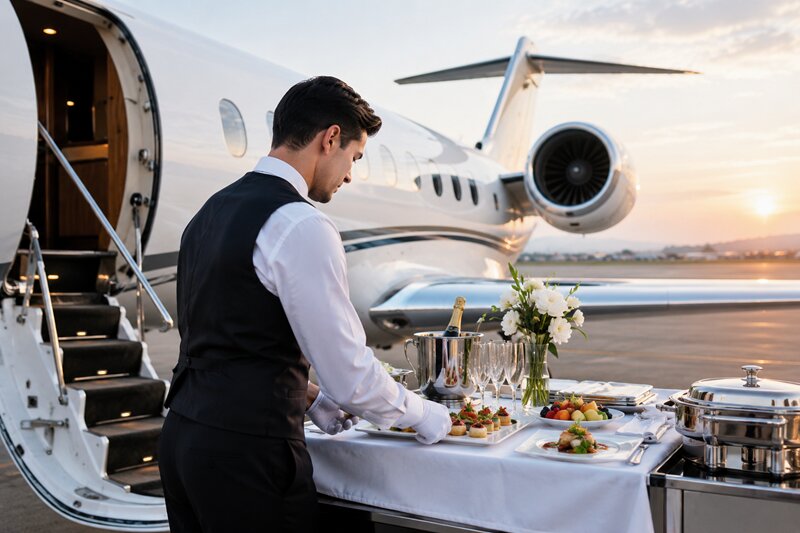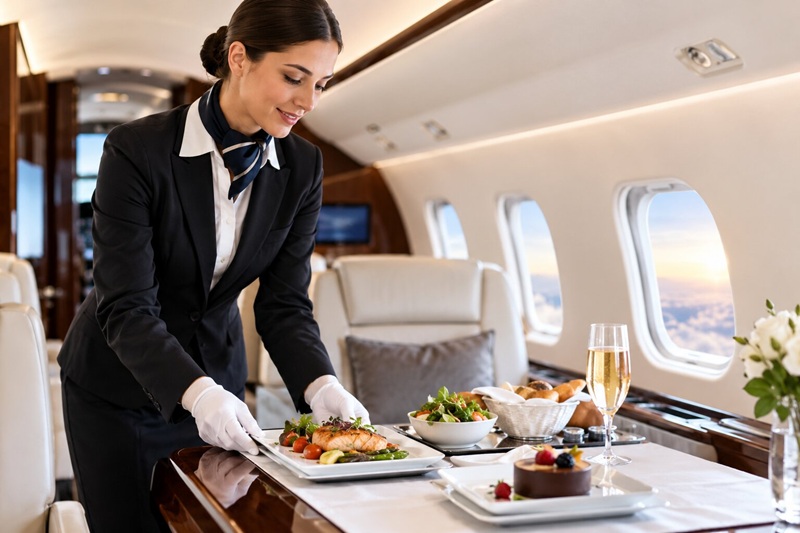
A flight department confirms a short-notice leg from Dubai to a remote airfield in East Africa. The principal expects the same dining standard on board as at a five-star hotel. The caterer who looked polished online must now deliver a multi-course service to a distant ramp, correctly packed, chilled, and documented. This is the gap a buyer's guide has to close. Menu photos and price lists reveal little about performance under real aviation conditions. This guide explains what premium actually means in private jet catering, which standards to verify, how to brief a provider correctly, and what shapes your final invoice, so you can order with confidence in 2026.
What Premium Means in Private Jet Catering in 2026
Demand for business aviation keeps climbing. Operators logged 3.9 million flights worldwide in the first eight months of 2025, with July and August both setting records, according to WingX flight activity data presented at the JetNet iQ Summit. Looking ahead, Honeywell's 2025 Global Business Aviation Outlook expects new business jet deliveries in 2026 to run 5 percent higher than in 2025, with 91 percent of surveyed operators planning to fly more or about the same. More flights mean more meals ordered under pressure, and a wider gap between providers who sell food and those who manage it as an aviation service.
Premium inflight catering rests on three pillars:
- Sourcing quality: ingredients and preparation at the level of leading restaurants and five-star hotels
- Aviation logistics: packaging, chilling, delivery windows, and ramp access handled without error
- Compliance: documented food safety, allergen control, and traceability on every order
A provider that excels at one pillar but neglects the others is a risk, not premium.
The Buyer's Checklist: Six Things to Verify Before You Order
Use this checklist during vendor evaluation.
1. Food Safety and HACCP Compliance
Ask for evidence of HACCP-based procedures, cold chain monitoring, and allergen segregation. Food prepared hours before wheels-up and consumed at altitude leaves no margin for error. Top flight caterers document every control point, from kitchen temperatures to sealed transport, and can show that documentation on request. If a provider hesitates when asked about food safety records, keep looking. The detailed rules of catering on private jets explain why these controls exist and how crews apply them on board.
2. Network Depth and Airport Coverage
A single kitchen cannot serve a global flight schedule. Evaluate how many airports a provider can actually reach and who cooks at each one. Dark Wing Inflight works through a vetted network of 2,800+ partners, including Michelin-starred chefs, renowned restaurants, and five-star hotels, covering more than 2,000 airports across 135 countries. A departure from Los Angeles International draws on dedicated inflight catering at LAX rather than an improvised local arrangement.
3. Menu Design for Altitude
Cabin pressure and dry air dull the perception of salt and sweetness, so dishes seasoned perfectly on the ground can taste flat at 40,000 feet. Experienced chefs compensate with brighter acidity, umami depth, and aromatics that survive reheating. They also design around galley limitations, since a light jet with a warming drawer cannot handle the same menu as a long-range aircraft with a full galley. The bespoke meal options built for private jets show how structure, sauce, and plating change when a dish must travel, chill, and reheat well.
4. Lead Times, Packaging, and Delivery Logistics
Premium providers quote realistic lead times and meet them. Standard orders typically need 12 to 24 hours, and elaborate multi-course services may need up to 48, while genuine round-the-clock operations can still handle short-notice requests. Confirm how food is packed for your galley type, how it is chilled during transport, and how the driver gains ramp or FBO access.
5. Dietary, Religious, and Cultural Accuracy
VIP passengers expect kosher, halal, Jain, gluten-free, and allergy-safe meals prepared correctly, not approximately. Government and military flights add protocol considerations on top. Ask how requirements are recorded, who verifies them in the kitchen, and how substitutions are communicated before departure. Cultural accuracy also covers presentation, service order, and menus written in the passenger's language where appropriate.
6. Communication and Availability
Aviation does not keep office hours. Schedules change at midnight, and a diversion can move your catering requirement to another country. Verify that your provider offers genuine 24/7/365 coverage with multilingual coordinators, a named point of contact, and proactive status updates.
How to Brief a Caterer: A Five-Step Process
A precise brief prevents most catering failures. Follow these steps for every order.
- Share the full flight context. Tail number, aircraft type, galley equipment, passenger and crew counts, departure airport, FBO, and wheels-up time. The provider plans packaging and delivery around these facts.
- Lock dietary and cultural requirements in writing. Verbal notes get lost between coordinators and kitchens. A written brief creates accountability and a reference point if anything is questioned later.
- Specify service style and timing. Plated courses for a long sector differ from boxed service on a 90-minute hop. State when each meal will be served so chilling and reheating instructions match.
- Confirm the delivery window and ramp access. Agree a delivery time 60 to 90 minutes before departure and confirm who meets the driver.
- Request written confirmation and a day-of contact. A final order summary plus a direct phone number for the delivery window turns a transaction into a managed service.
Teams with frequent orders can centralize requests through one coordination desk. The approach outlined in the smartest way to manage inflight catering reduces errors across multi-leg trips and recurring routes.
What You Are Paying For
Costs vary widely, and the invoice reflects far more than ingredients. A premium catering company for private jet flights prices each order around six factors:
- Ingredient sourcing, including out-of-season produce and specialty imports
- Skilled labor, often chefs from acclaimed kitchens working to aviation specifications
- Aviation-grade packaging that protects presentation through transport and reheating
- Cold chain transport plus airport or FBO access fees
- Timing, since overnight and short-notice orders carry premiums
- Destination difficulty, because remote locations involve longer supply chains
Treat unusually low quotes with caution. They usually signal corners cut on sourcing, packaging, or safety.
Ordering for Difficult Destinations
Catering a departure from London Luton, Teterboro, or Dubai is straightforward for any established provider. The real test comes at island airports in the Caribbean, high-altitude fields in the Andes, or remote strips across Central Asia and sub-Saharan Africa, where cold chain infrastructure is thin and premium ingredients may travel hundreds of kilometers. Strong providers solve this through local partnerships, advance positioning of supplies, and honest communication about what can realistically be delivered at a given airfield. Ask for recent examples at your specific destination.
Order with Confidence on Your Next Flight
Choosing the right catering partner comes down to verification, not marketing. Check safety documentation, test network coverage against your actual routes, insist on written briefs, and judge providers by how they perform at difficult airports, not just major hubs. The partners worth keeping combine restaurant-grade cuisine with aviation-grade logistics and answer the phone at 3 am.
Dark Wing Inflight supports flight departments, charter operators, and government clients with exactly this combination: a global partner network, multilingual coordinators available 24/7/365, and HACCP-compliant preparation at every location. If you are still researching options, review our menus and airport coverage at your own pace. If you have a flight on the schedule, our team can confirm menus and logistics today. Call +44 204 577 0985, message us on WhatsApp at +33 787 346 458, or email info@darkwinginflight.catering to place your order.
Frequently Asked Questions
How far in advance should I order catering for a private jet?
Place standard orders 12 to 24 hours before departure, and allow up to 48 hours for elaborate multi-course menus, rare ingredients, or strict religious preparation. Established providers with round-the-clock operations can often handle shorter windows at major hubs, though choice narrows as time shrinks. For remote airports, add buffer time for supply positioning.
What makes VIP inflight catering different from airline catering?
Airline catering is built for volume: thousands of identical trays at a fixed cost. VIP inflight catering is built for one aircraft and a handful of passengers, with menus designed around individual preferences, restaurant-level ingredients, and packaging matched to a specific galley. The service also includes direct coordination with crew, custom presentation, and flexibility when schedules change.
How much does private jet catering cost in 2026?
Expect a wide range. Light refreshments for a short flight often start at a few hundred dollars, while full multi-course VIP service with premium ingredients on a long-range sector can run into several thousand. Final pricing depends on menu complexity, sourcing, airport location, delivery timing, and packaging requirements. Request itemized quotes so you can compare providers on substance rather than headline numbers.
Can private jet caterers handle strict dietary and religious requirements?
Yes, provided the requirements are documented in advance. Credible providers prepare certified kosher and halal meals, Jain and vegan menus, and allergy-safe dishes with segregated preparation. Confirm in writing how the kitchen verifies each requirement and how substitutions are communicated. For medical-grade allergies, ask specifically about cross-contamination controls.
Which airports are the hardest to cater, and how is it managed?
Remote island destinations, high-altitude airfields, and airports with limited cold chain infrastructure present the greatest challenges, from parts of the Caribbean and the Andes to Central Asia and sub-Saharan Africa. Experienced providers manage these through local partner kitchens, pre-positioned supplies, and transparent guidance on realistic menu options for each location.