
Why Your Catering Partner Matters More Than Your Menu
A perfectly curated menu means nothing if the food arrives late, cold, or at the wrong airport. For flight departments, charter operators, and VIP travelers, the catering partner you choose determines more than just what passengers eat. It directly affects operational reliability, passenger satisfaction, and the reputation of every flight.
The global inflight catering market is projected to grow from USD 17.36 billion in 2025 to USD 18.77 billion in 2026, according to Mordor Intelligence. The private jet charter services market is expected to reach USD 45.43 billion by 2030. These numbers reflect a clear shift: more aircraft are in the air, more passengers have higher expectations, and the margin for catering errors is shrinking.
Yet many operators still select catering providers based on convenience or habit, not performance. This guide outlines the criteria that matter most when choosing a catering partner for flights, and how to evaluate providers with the rigor this decision deserves.
What Separates a Reliable Catering Partner from an Unreliable One
Not all catering providers are built for aviation. Restaurant kitchens operate on fixed schedules. Aviation kitchens must adapt to changing departure times, short-notice orders, altitude-specific food preparation, and strict delivery windows at FBOs across the world.
Here is what separates dependable providers from the rest:
- Operational flexibility: The ability to handle last-minute schedule changes, route diversions, and short-notice catering requests without compromising food quality.
- Aviation-grade food safety: Compliance with HACCP protocols, cold chain management, and packaging standards designed for galley environments and altitude conditions.
- Consistent quality at scale: The capacity to deliver the same standard of food and presentation whether the aircraft is departing from Teterboro, Dubai International, or a regional airstrip in sub-Saharan Africa.
- Logistics coordination: Accurate delivery timing synchronized with flight schedules, ground handlers, and FBO operations.
A provider that excels in one city but cannot replicate that performance globally creates a fragmented, unpredictable experience for passengers who expect consistency.
Global Coverage: Why Local Partnerships Define Service Quality
One of the most overlooked factors in catering selection is the provider's ground-level network. A global catering partner is only as strong as its local relationships at each airport.
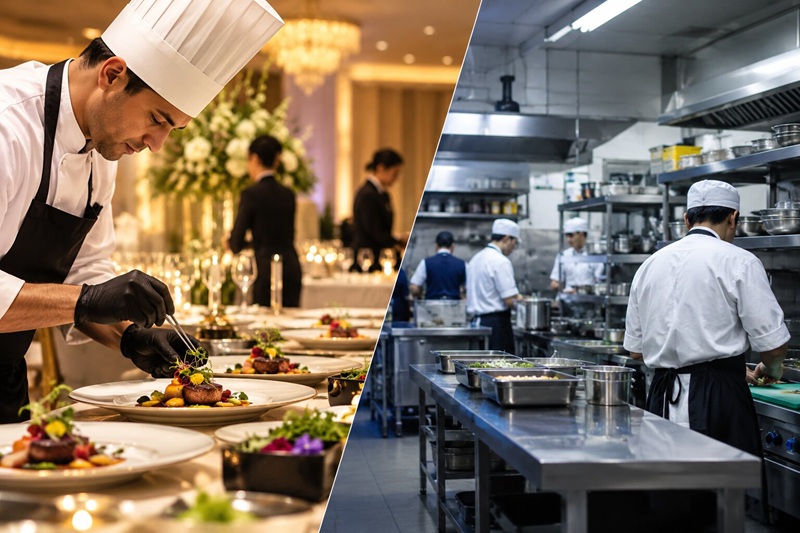
Dark Wing Inflight operates through a network of 2,800+ world-renowned restaurants, VIP caterers, 5-star luxury hotels, and Michelin-star chefs across 2,000+ airports in 135 countries. This network-based model ensures that whether your aircraft is departing from London Luton, Singapore Changi, Sao Paulo Congonhas, or a less-serviced airport in Central Asia, the catering meets the same exacting standards.
Why does this approach outperform centralized kitchen models?
- Local sourcing guarantees fresher ingredients, especially for destinations where importing specialty items would compromise quality or timing.
- Regional culinary expertise ensures that meals reflect authentic local flavors when requested, rather than generic international menus.
- On-the-ground logistics partners understand specific FBO requirements, delivery access points, and local regulations that vary from airport to airport.
For operators flying across multiple continents within a single trip, a partner with verified local relationships at each stop eliminates the need to coordinate with multiple vendors independently.
Food Safety and Compliance: Non-Negotiable Standards
Food safety in aviation is not optional. It is a regulatory and operational requirement that protects passengers and crew. At altitude, the consequences of foodborne illness are compounded by limited medical resources and restricted diversion options.
Key food safety elements to verify in any catering partner:
- HACCP certification across all preparation and handling stages
- Cold chain integrity from kitchen to aircraft, with documented temperature controls
- Allergen management protocols that account for cross-contamination risks in shared kitchen environments
- Ingredient traceability for all components of every meal
- Packaging standards that maintain food temperature, texture, and safety during ground transport and onboard storage
Industry analysts note that caterers are increasingly adopting AI-driven menu planning, robotic tray assembly, and IoT-enabled cold storage to reduce waste and improve reliability. These technologies are becoming differentiators among top-tier providers.
When reviewing a potential partner, request documentation of their food safety protocols. Ask how they handle allergen declarations. Confirm whether they conduct regular third-party audits. A provider that cannot produce these documents quickly likely does not maintain them consistently.
Cultural Sensitivity and Dietary Customization
Private and government aviation serves passengers from every cultural, religious, and dietary background. A catering partner must be equipped to handle:
Halal, kosher, Hindu vegetarian, and Jain dietary requirements with certified sourcing
Regional cuisine preferences that align with passenger origin or destination
Medical dietary restrictions including low-sodium, diabetic-friendly, gluten-free, and allergen-free meals
Lifestyle-driven preferences such as plant-based, keto, paleo, and performance nutrition menus
This capability goes beyond offering a few alternative menu items. It requires genuine understanding of cultural food practices, access to certified suppliers, and the operational discipline to keep restricted meals entirely separate from standard preparation lines.
For government and military flights carrying officials from diverse backgrounds, cultural competence in catering is a matter of diplomatic protocol. For VIP private jet catering, it is a reflection of the host's attention to detail and respect for their guests.
24/7 Availability and Response Time
Flight schedules do not follow business hours. Departures shift. Routes change. Passengers arrive with new dietary requirements hours before takeoff. The catering partner you choose must operate on aviation time, not restaurant time.
Critical availability benchmarks to evaluate:
Round-the-clock ordering: Can you place or modify an order at 3:00 AM local time and receive confirmation within minutes?
Multilingual support: Can the team communicate in the language of your crew, passengers, or local ground handlers?
Minimum lead time: What is the shortest notice the provider can accommodate without quality compromise?
Contingency protocols: How does the provider handle diversions, cancellations, or sudden passenger count changes?
Dark Wing Inflight provides 24/7/365 multilingual service, ensuring that flight departments and charter operators always have a responsive point of contact regardless of time zone or location.
How to Structure a Catering Partner Evaluation
Step 1: Define your operational profile. Map your most frequent routes, typical passenger profiles, and common dietary requirements. Identify airports where you have had catering issues in the past.
Step 2: Shortlist providers based on coverage. Eliminate any provider that cannot service your most-used airports and at least two-thirds of your secondary destinations.
Step 3: Request a food safety documentation package. Ask for HACCP certificates, cold chain procedures, allergen protocols, and audit reports.
Step 4: Conduct trial orders. Place test orders at three to five airports, including at least one short-notice request. Evaluate food quality, packaging, delivery timing, and communication.
Step 5: Assess communication and account management. Test responsiveness across time zones. Confirm whether you have a dedicated contact or are routed through a generic support queue.
Step 6: Review pricing transparency. Understand how pricing works for standard orders, premium requests, last-minute changes, and cancellations. Hidden fees erode trust quickly.
The Role of Technology in Modern Flight Catering
The inflight catering industry is evolving rapidly. Leading providers now integrate technology into their operations to improve accuracy, reduce waste, and speed up service delivery.
Technologies shaping the future of flight catering include:
- Digital ordering platforms that allow real-time menu selection, order tracking, and modification
- AI-powered menu planning that optimizes ingredient use and reduces food waste
- IoT-enabled cold chain monitoring that provides real-time temperature data from kitchen to aircraft
- Automated invoicing and reporting that simplifies procurement for flight departments managing multiple orders across regions
As the private aircraft market is projected to grow from USD 29.87 billion in 2025 to USD 41.38 billion by 2030, the demand for technologically advanced catering solutions will continue to rise alongside fleet expansion and passenger expectations.
Frequently Asked Questions (FAQs)
How do I choose the best catering partner for my private flights?
Start by assessing coverage, food safety compliance, and the provider's ability to customize menus for your passengers. The right partner should operate across the airports you use most frequently, hold HACCP certification, and offer 24/7 ordering with multilingual support. Request trial orders at multiple airports to test food quality, delivery timing, and communication responsiveness before committing to a long-term arrangement. Pricing transparency is equally important. A reliable catering partner will provide clear quotes without hidden fees and will have contingency protocols for schedule changes and diversions.
What food safety certifications should a flight catering provider have?
At a minimum, any reputable flight catering provider should hold HACCP certification and maintain documented cold chain management procedures. Additional certifications to look for include ISO 22000 for food safety management systems and any local aviation authority food handling approvals. Ask potential providers for copies of their most recent third-party audit reports and allergen management protocols. These documents indicate whether food safety is embedded in daily operations or treated as a checkbox exercise.
Can a catering partner accommodate halal, kosher, or allergen-free meals on short notice?
Top-tier providers maintain relationships with certified halal and kosher suppliers and can source allergen-free meals with appropriate lead time. The key factor is whether the provider has pre-vetted suppliers and established protocols for these requirements or needs to arrange them from scratch for each order. At Dark Wing Inflight, our network of 2,800+ partners includes certified specialists for religious, cultural, and medical dietary needs across 135 countries, enabling us to accommodate these requests reliably even at short notice.
How far in advance should I order catering for a VIP flight?
Standard catering orders are typically placed 24 to 48 hours before departure, which allows the catering partner to source premium ingredients and prepare meals to the highest standard. However, many providers, including Dark Wing Inflight, can accommodate shorter lead times depending on the destination and menu complexity. For elaborate multi-course meals, specialty dietary requirements, or departures from remote airports, providing 48 to 72 hours of notice is recommended. Always confirm minimum lead times with your provider for each specific airport.
Why is global airport coverage important when selecting a catering partner?
Operators who fly internationally need a single catering partner that can deliver consistent quality at any departure point. Working with different local providers at each airport creates inconsistency in food quality, packaging standards, and communication. A partner with verified relationships across thousands of airports eliminates this fragmentation. It also reduces the administrative burden on flight departments, since one point of contact manages sourcing, preparation, and delivery coordination worldwide, regardless of the destination.
Final Thought
The right catering partner does not just feed your passengers. They protect your schedule, your reputation, and your operational integrity at every departure point around the world. Invest the time to evaluate providers properly, and the return shows up in every flight.